
Best ways to compare flooring installation quotes in 2026
Compare flooring installation quotes using a shared scope and clear exclusions. Check preparation, removal and variations before you choose a tradie.

Best overall: compare a shared written scope. Best for an uneven floor: compare preparation details. Best for controlling extras: compare exclusions and variation rules. To compare flooring installation quotes in 2026, check that each tradie is quoting the same floor, preparation and finishing work before you judge the total.
TL;DR- Compare flooring installation quotes against the same room list, flooring specification and preparation requirements.
- QuickQuote suits homeowners comparing flooring installation quotes who want free job posting and control over hiring.
- Check removal, floor preparation, door adjustments and rubbish disposal separately.
- QuickQuote connects homeowners with up to three local tradies, not a guaranteed three quotes.
Why this matters
A flooring quote can cover installation alone or a wider job that includes removing the old floor, preparing the surface and fitting trims. Those are different scopes. A lower total does not tell you which one you are buying.
QuickQuote is a quote-matching marketplace, not the contractor doing the work. You can post a home-service job for free, receive quotes from up to three local tradies, with no connection fee, and choose who to hire.
For your 2026 flooring job, start with the written scope rather than a preferred total. Ask each tradie to identify what is included, what needs inspection and what remains your responsibility.
What makes the best flooring quote comparison
Use these criteria before choosing a comparison method:
- Matching scope: the same rooms, flooring specification and installation work appear in every quote.
- Preparation detail: removal, surface preparation and any unresolved floor conditions are identified.
- Clear boundaries: supply, furniture moving, trims and waste disposal have named responsibilities.
- Controlled changes: extra work requires a written explanation and your approval.
- Relevant evidence: the tradie can explain comparable work, installation requirements and handover terms.
These criteria matter more than how polished the quote looks. A short document with clear boundaries is easier to assess than a long document full of unspecified allowances.
Flooring quote comparison methods at a glance
| Method | Best for | Standout feature | Key limitation |
|---|---|---|---|
| Shared-scope comparison | Choosing between complete quotes | Lines up the same job across tradies | Depends on an accurate brief |
| Preparation comparison | Uneven, damaged or covered floors | Separates installation from underlying work | Hidden conditions still need assessment |
| Inclusions checklist | Managing supply and finishing responsibilities | Exposes gaps between trades and homeowner tasks | Cannot assess workmanship alone |
| Variation review | Jobs with unresolved conditions | Sets approval rules before extras arise | Does not remove uncertainty |
| Evidence and handover review | Choosing between otherwise similar quotes | Tests experience and completion terms | References do not replace a clear scope |
1. Shared scope: best for choosing between complete quotes
A shared-scope comparison puts every tradie against the same written job description. It is the best starting point because you cannot fairly compare different rooms, materials or finishing requirements as though they were identical.
Create one brief and send the same version to everyone. If an inspection changes the brief, share that change with the other tradies before choosing.
Shared-scope comparison pros:
- Makes omitted rooms and tasks easier to spot.
- Keeps supply-and-install separate from installation-only work.
- Gives each tradie the same opportunity to explain assumptions.
Shared-scope comparison cons:
- An incomplete brief carries the same gaps into every quote.
- Room measurements alone do not describe the condition underneath existing flooring.
Use 3 columns in your comparison sheet: the required task, the tradie's inclusion and the unanswered question. Keep separate sheets for each quote rather than squeezing qualifications into a single total.
Best for: homeowners who have decided what flooring work they want.
Verdict: Use shared scope as your default comparison method.
2. Preparation review: best for uncertain floor conditions
A preparation review checks what must happen before the new flooring goes down. Ask the installer to explain the existing surface, the proposed installation method and the checks needed for the selected flooring.
Do not treat an unseen floor as an assessed floor. If old carpet or another covering remains in place, ask which conclusions require removal or inspection first.
Preparation review pros:
- Distinguishes laying the floor from preparing it.
- Identifies assumptions about the existing surface.
- Makes responsibility for assessment and remedial work explicit.
Preparation review cons:
- Concealed conditions cannot be settled by photographs alone.
- A preparation allowance without a defined scope still leaves uncertainty.
Ask whether the quote addresses removal, adhesive residue, surface repairs, levelling and any moisture assessment required for the flooring system. These are questions to resolve, not tasks to assume every room needs.
For a 2026 quote, request a written explanation of what has been inspected and what remains provisional. That distinction is more useful than a broad promise to make the floor ready.
Best for: homeowners replacing flooring over an uncertain or damaged surface.
Verdict: Use preparation review before accepting unresolved floor assumptions.
3. Inclusions checklist: best for managing job boundaries
An inclusions checklist identifies who supplies, moves, removes and finishes each part of the job. It is especially useful when you buy the flooring separately or arrange other work around installation.
Work through the room from the existing floor to the finished doorway. Name the tasks between those points rather than relying on the phrase complete installation.
Inclusions checklist pros:
- Clarifies responsibility for materials and accessories.
- Exposes gaps around furniture, trims and waste.
- Helps coordinate work that sits outside the installer's scope.
Inclusions checklist cons:
- A checked box does not describe the quality of the finish.
- A checklist needs updating when the flooring specification changes.
Confirm whether the quote includes underlay or adhesive where relevant, doorway transitions, skirting removal or refitting, and adjustments to doors. Ask who handles packaging and the removed flooring.
If you supply materials, ask who confirms quantities and suitability before ordering. Do not assume the installer accepts responsibility for a product simply because they have quoted labour.
Best for: homeowners splitting supply, installation and finishing between different people.
Verdict: Use an inclusions checklist whenever responsibilities are shared.
4. Variation review: best for controlling uncertain extras
A variation review examines how changes to the agreed job will be documented and approved. It does not make hidden conditions disappear. It gives you a process for deciding what happens when the original scope no longer fits.
Ask the tradie to separate known work from provisional work. Then confirm how the tradie will explain a change before proceeding.
Variation review pros:
- Keeps additional work attached to a written decision.
- Makes provisional items visible before you commit.
- Gives you a chance to question scope changes.
Variation review cons:
- Approval rules cannot establish the condition of a concealed surface.
- Vague descriptions of extra work remain hard to compare.
Use 2 stages: establish the agreed scope before work starts, then require written approval for changes. Ask for the reason, the revised work and the effect on the agreed schedule and total.
For your 2026 comparison, flag phrases such as preparation as required or extras to be advised. Ask what triggers those extras and how they will be assessed.
Best for: homeowners whose job includes unresolved preparation or design decisions.
Verdict: Use variation review before accepting provisional work.
5. Evidence review: best for choosing between similar quotes
An evidence review checks whether the tradie can explain relevant past work and the proposed installation approach. Use it after scope and exclusions are clear, not instead of them.
Ask about jobs involving the same flooring type and a similar existing surface. A general gallery tells you less than an explanation of a comparable installation and its challenges.
Evidence review pros:
- Connects experience to the actual job.
- Gives you questions beyond the quoted total.
- Brings completion checks and handover into the decision.
Evidence review cons:
- Selected photos do not show every part of an installation.
- A positive reference does not define your contract or inclusions.
Ask who will carry out the work, who answers questions during installation and how concerns will be recorded at handover. Confirm any warranty terms in writing, including who provides the warranty and what it covers.
Best for: homeowners choosing between quotes with genuinely comparable scopes.
Verdict: Use evidence review as the final tie-breaker, not the first filter.
Write a job brief that makes quotes comparable
Before you post a flooring job on QuickQuote, give tradies enough detail to identify the work and the unknowns. A clear brief helps the comparison; it does not replace an inspection where one is needed.
Build the brief around these 5 checks:
- Rooms: list each room and whether wardrobes, stairs or landings are included.
- Existing floor: describe the visible covering and any known damage.
- New flooring: state the selected material or explain that selection is still open.
- Access: describe furniture, stairs, parking restrictions and whether the home is occupied.
- Finish: identify transitions, skirting, door clearance and rubbish removal requirements.
Attach room photos and note whether measurements are approximate. Ask the installer to verify quantities rather than treating a homeowner's sketch as a final materials order.
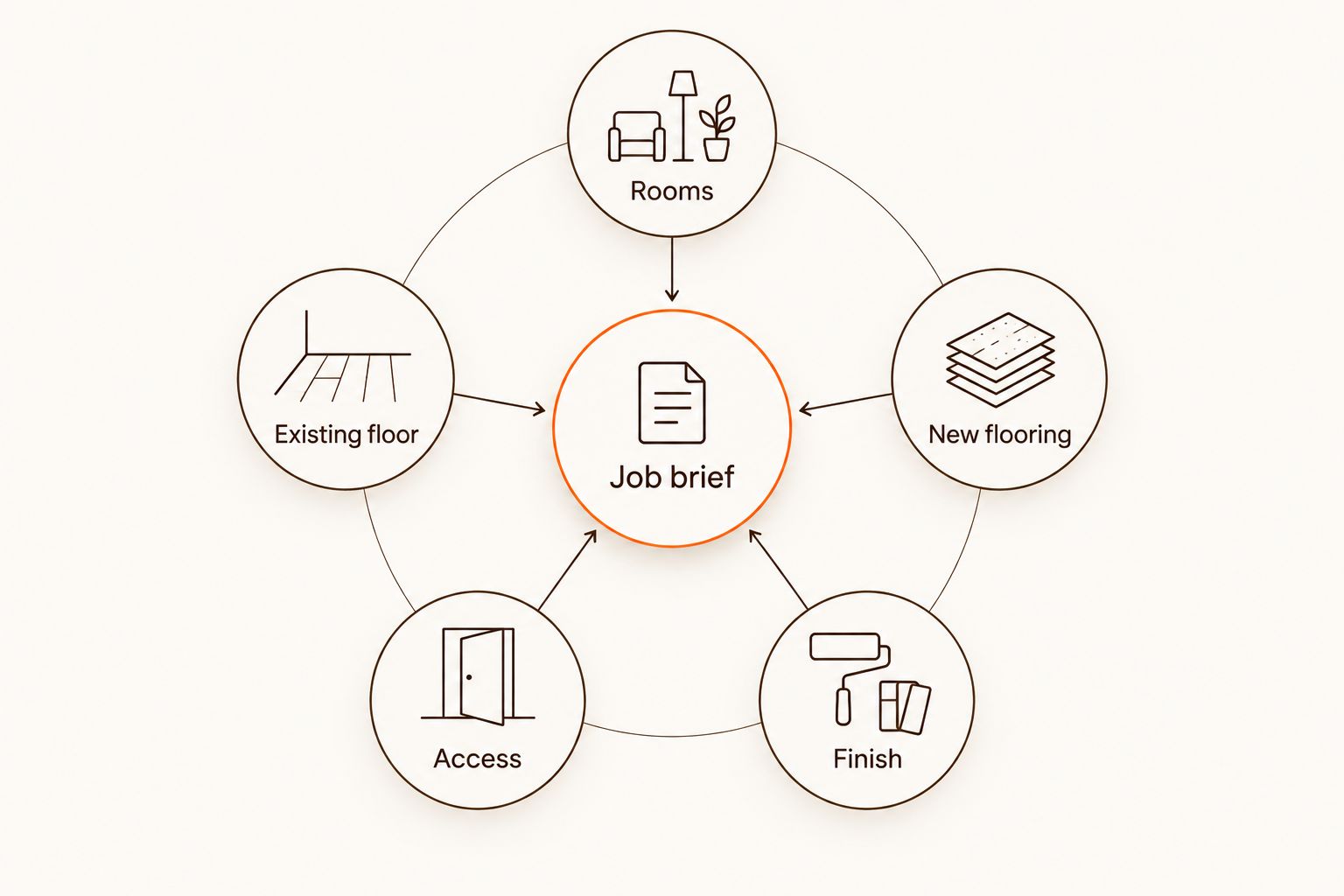
Keep the original brief with the quotes. If you change the selected flooring or add another room, request an updated written scope rather than relying on a conversation.
Use recommendations without skipping the quote checks
A recommendation gives you a reason to ask a tradie about relevant experience. It does not establish what your flooring installation includes. Ask the person making the recommendation what work was done, how changes were handled and whether any concerns were resolved.
Understanding why recommendations can outweigh quotes starts with the distinction between evidence about a tradie's work and a document describing your own job. You need both: confidence in the person and agreement about the work.
Keep recommendations specific. Experience installing your chosen flooring over a comparable surface is more relevant than a general comment that someone was friendly or easy to contact.
Check the quote before you accept
Read the quote again as a set of responsibilities, not just a total. Your 2026 shortlist should identify the flooring specification, work areas, preparation, exclusions and approval process in writing.
Confirm these points directly:
- Does the quote identify the business doing the work?
- Is supply included, or are you providing the flooring?
- Are the proposed dates and access arrangements agreed?
- Are payment stages and GST treatment clear?
- Does the quote distinguish completed work from provisional items?
- What happens if either party wants to change the scope?
Check any licensing or registration requirements that apply to the work in your state or territory. Requirements depend on the location and work involved; do not assume a marketplace listing replaces that check.
Keep the accepted quote, agreed changes and completion notes together. Those records make the agreed job easier to follow when questions arise.
How the methods are ranked
Shared scope ranks first because every other check depends on knowing what job is being quoted. Preparation follows because unresolved surface work needs separate attention before installation is agreed.
Inclusions and variation reviews then define responsibilities and changes. Evidence review comes last because relevant experience helps you choose between comparable offers, but cannot repair an unclear scope.
These are complementary checks, not competing services. Use the full sequence when the job includes removal, uncertain preparation or several people supplying different parts.
Which comparison method should you choose?
Start with shared scope, then investigate the biggest unresolved item. Choose preparation review for uncertain surfaces, an inclusions checklist for split responsibilities, and variation review for provisional work.
QuickQuote is best for homeowners who want to post a home-service job for free and choose who to hire. When comparing flooring installation quotes, keep that control by asking for written answers before accepting an offer.
Post a clear home-service job
Free to post, no connection fee, and up to three local tradies. You choose who to hire.
Post your jobFAQ
What's the best way to compare flooring installation quotes?
Compare flooring installation quotes against the same written scope. Match the rooms, flooring specification, preparation, finishing work and exclusions before judging the totals.
Should I choose the lowest flooring installation quote?
Do not choose on the total alone. First establish whether each quote includes the same work and whether any unresolved preparation or exclusions change the comparison.
What should a flooring installation quote include?
A flooring installation quote should identify the work areas, flooring specification, installation scope, responsibilities and exclusions. Ask for preparation, removal, trims and disposal to be addressed explicitly rather than assumed.
Can a tradie give a final flooring quote from photos?
Photos do not establish concealed floor conditions. Ask the tradie which parts can be quoted from the information supplied and which require an inspection or removal of the existing covering.
How do I compare installation-only and supply-and-install quotes?
Separate material supply from installation and associated work. Confirm who supplies accessories, checks quantities, assesses suitability and deals with material-related problems.
What should happen if the installer finds unexpected floor damage?
Ask the installer to explain the finding and proposed change in writing before additional work proceeds. Confirm the revised scope and its effect on the agreed total and schedule.
Does QuickQuote guarantee three flooring quotes?
QuickQuote does not guarantee three quotes. Homeowners can post a home-service job for free and receive quotes from up to three local tradies, with no connection fee, then choose who to hire.
One last thing
Ask each shortlisted tradie: What have you assumed I will organise? That question brings furniture moving, material supply, access and waste responsibilities into the open.
For a flooring job in 2026, the useful answer is not nothing to worry about. It is a written list you can check against the quote before work starts.
Related guides

Connecting homeowners with trusted local tradies. Made in Sydney.