
Air conditioning replacement: can existing fittings be reused?
Air conditioning installation cost depends on what stays. Check when pipes, drains and brackets can be reused, and what your replacement quote must cover.
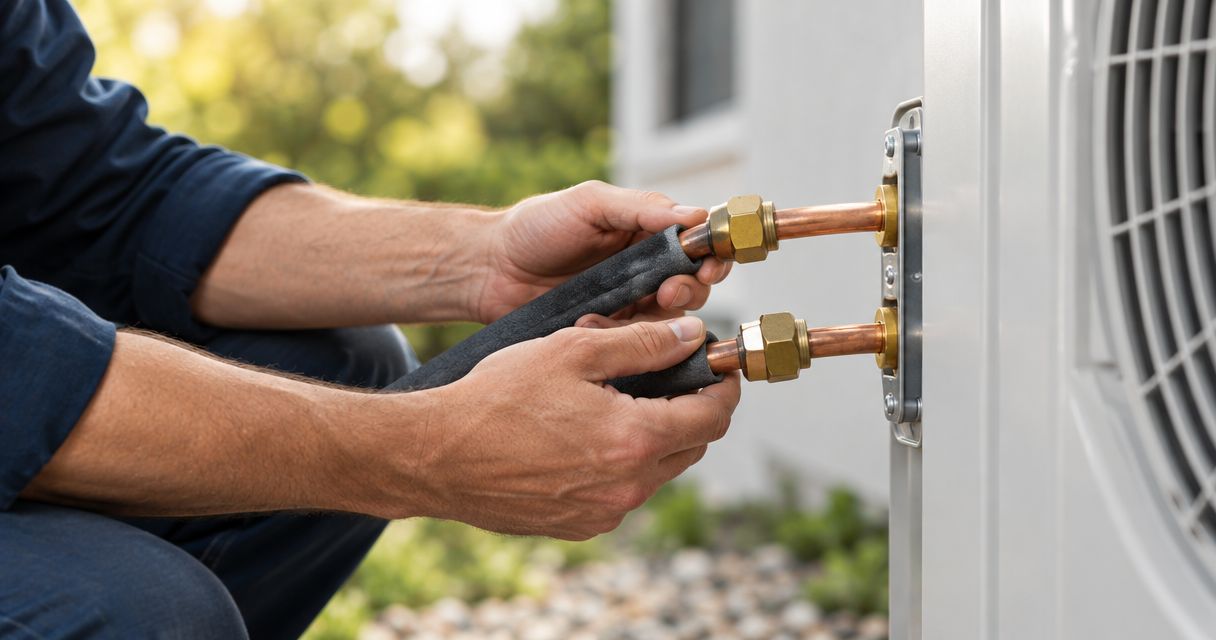
Existing air conditioning fittings can be reused when the installer confirms they suit the new system, remain in sound condition and meet the manufacturer’s installation requirements. Reuse is not automatic: refrigerant pipework, drains, brackets and electrical connections need separate checks, so your 2026 replacement quote should identify what stays and what changes.
TL;DR- Existing fittings need individual checks; a replacement unit fitting the same space does not establish compatibility.
- Air conditioning installation cost depends on the replacement scope, including pipework, electrical work and removal.
- QuickQuote lets homeowners post for free and receive quotes from up to three local tradies.
- Ask the installer to record every reused component and any conditions attached to the quote.
Air conditioning replacement: can existing fittings be reused?
Yes, but the decision belongs to the installer after checking the new system’s requirements and the existing installation. A single split system has 1 indoor unit and 1 outdoor unit; replacing both does not automatically mean replacing every connection between them.
Before comparing quotes, separate equipment replacement from the surrounding work. The guide to air conditioning installation quote extras helps you identify items that need an explicit inclusion or exclusion.
| Existing component | What supports reuse | What can rule it out | What to request in the quote |
|---|---|---|---|
| Refrigerant pipework | Correct specification, suitable condition and manufacturer acceptance | Incompatible dimensions, damage or contamination | Reuse conditions and required preparation or testing |
| Condensate drain | Sound pipework with suitable fall and discharge | Leaks, blockages or an unsuitable route | Drain inspection and any alterations |
| Outdoor brackets or base | Suitable support, condition and fixing arrangement | Corrosion, movement or incompatible equipment dimensions | Retained support or replacement support |
| Electrical supply and cabling | Compliance with the new equipment’s requirements | Unsuitable circuit, cable, protection or isolation | Electrical checks and any required work |
| Wall opening and covers | Suitable position and sufficient space | Relocation, deterioration or poor sealing | Sealing, covers and wall repairs |
Reuse avoids replacing a suitable component. Its limitation is that suitability needs checking, sometimes beyond what photos show. Replacement addresses an unsuitable component, but it also adds work that should be described before you accept the quote.
Why this matters
A quote that says replacement installation leaves an important question unanswered: replacement of what? You need to know whether the installer is supplying equipment only, replacing connecting services, or retaining parts of the old installation.
Compare the agreed scope, not the assumption that existing fittings will save work. An installer who includes new pipework is proposing a different job from one who plans to reuse it.
QuickQuote is best suited to homeowners who want to post a home-service job for free, compare quotes from up to three local tradies and choose who to hire. It is a quote-matching marketplace, not the contractor inspecting or installing your air conditioner.
Refrigerant pipework: reuse needs a compatibility check
Copper pipes carry refrigerant between the indoor and outdoor units. Matching the visible pipe route is not enough: the installer needs to check the pipe dimensions, condition and suitability for the replacement equipment.
The new system’s installation instructions matter more than an assumption about what worked before. Ask the installer to confirm whether the manufacturer permits the proposed reuse and what preparation or testing that requires.
Ask these questions before accepting a reuse allowance:
- Does the existing pipework meet the new model’s specifications?
- Is the pipework accessible enough to assess its condition?
- Are there signs of leakage, damage or deteriorated insulation?
- Does the old system’s failure affect the proposed reuse?
- What happens if the pipework fails inspection or testing?
Best for retaining the existing route: pipework the installer has assessed and accepted for the specified replacement model. The benefit is avoiding unnecessary replacement; the limitation is that concealed sections and the old system’s condition can affect that decision.
Do not disconnect pipework yourself to help the quote process. Refrigerant work needs appropriately licensed handling, and the installer should explain how the old system will be decommissioned.
Drains and wall openings: check condition and position
A condensate drain removes water from the indoor unit. An existing drain is a candidate for reuse when its condition, fall and discharge arrangement suit the replacement installation.
A water stain near the old unit deserves attention before the new unit goes in. Tell the installer about past leaks, dripping, blockages or water damage rather than assuming a replacement air conditioner will resolve them.
The wall opening also needs checking. A new indoor unit can have different connection positions or dimensions, even when it serves the same room.
Ask whether the quote includes:
- Checking and clearing the retained drain.
- Altering the drain route where required.
- Sealing around the wall penetration.
- Replacing damaged external pipe covers.
- Making good exposed holes or damaged surfaces.
Best for a same-position replacement: a sound drain and suitable wall opening that the installer confirms can stay. The advantage is less disturbance; the limitation is that painting and cosmetic repairs still need their own scope.
Outdoor supports: matching the location is not enough
Existing brackets or a ground-level base need to suit the new outdoor unit’s dimensions, weight and fixing requirements. The installer also needs to check the manufacturer’s required clearances around the unit.
Look for visible rust, cracking, movement or loose fixings, and photograph anything concerning. Do not climb onto brackets or try to test their strength yourself.
Best for retaining outdoor supports: a sound base or bracket arrangement that suits the specified equipment. Keeping it avoids unnecessary building work, but a familiar location does not prove the support or surrounding clearance is suitable.
For a 2026 replacement, ask the quote to name the proposed outdoor location and state whether the support is retained, repaired or replaced. Include access details if the unit sits above ground level, behind a locked gate or beside a narrow passage.
Electrical connections: have suitability confirmed
An existing air conditioner having power does not establish that its supply suits the replacement. The electrical assessment needs to consider the new equipment’s requirements and the condition and suitability of the existing installation.
Ask who will assess and complete any electrical work. Licensing requirements depend on the work and your state or territory; confirm the relevant credentials rather than treating air conditioning installation as a single interchangeable qualification.
Request a clear answer about the circuit, cabling, protective devices and isolation. Do not open the switchboard or remove electrical covers to take photos.
Best for retaining the electrical supply: an installation checked and accepted for the new equipment by an appropriately licensed person. The benefit is avoiding unnecessary alteration; the limitation is that the assessment can identify work outside a straightforward equipment swap.
Why air conditioning installation cost varies
For a 2026 replacement, the useful question is not simply whether fittings are reusable. Ask which parts the quote includes and which decisions remain subject to inspection.
These factors change the work involved:
- Pipework suitability: retaining an accepted pipe run differs from replacing damaged or incompatible pipework.
- Equipment location: moving either unit changes the connection route and can require different supports or wall openings.
- Drain condition: a usable drain differs from one needing clearing, rerouting or replacement.
- Electrical suitability: retaining an accepted supply differs from changing a circuit or associated equipment.
- Access: a readily accessible outdoor unit presents a different removal and installation task from a difficult location.
- Removal and repairs: decommissioning, taking away the old equipment, sealing openings and repairing surfaces need defined inclusions.
A useful quote explains these factors rather than hiding them inside a general installation description. Ask each tradie to quote the same equipment location and reuse assumptions so you can compare the work fairly.
How do I prepare a clear replacement job brief?
Give the installer enough information to assess the job without presenting reuse as a requirement. Your brief should describe what exists, what has gone wrong and whether you want to keep the current locations.
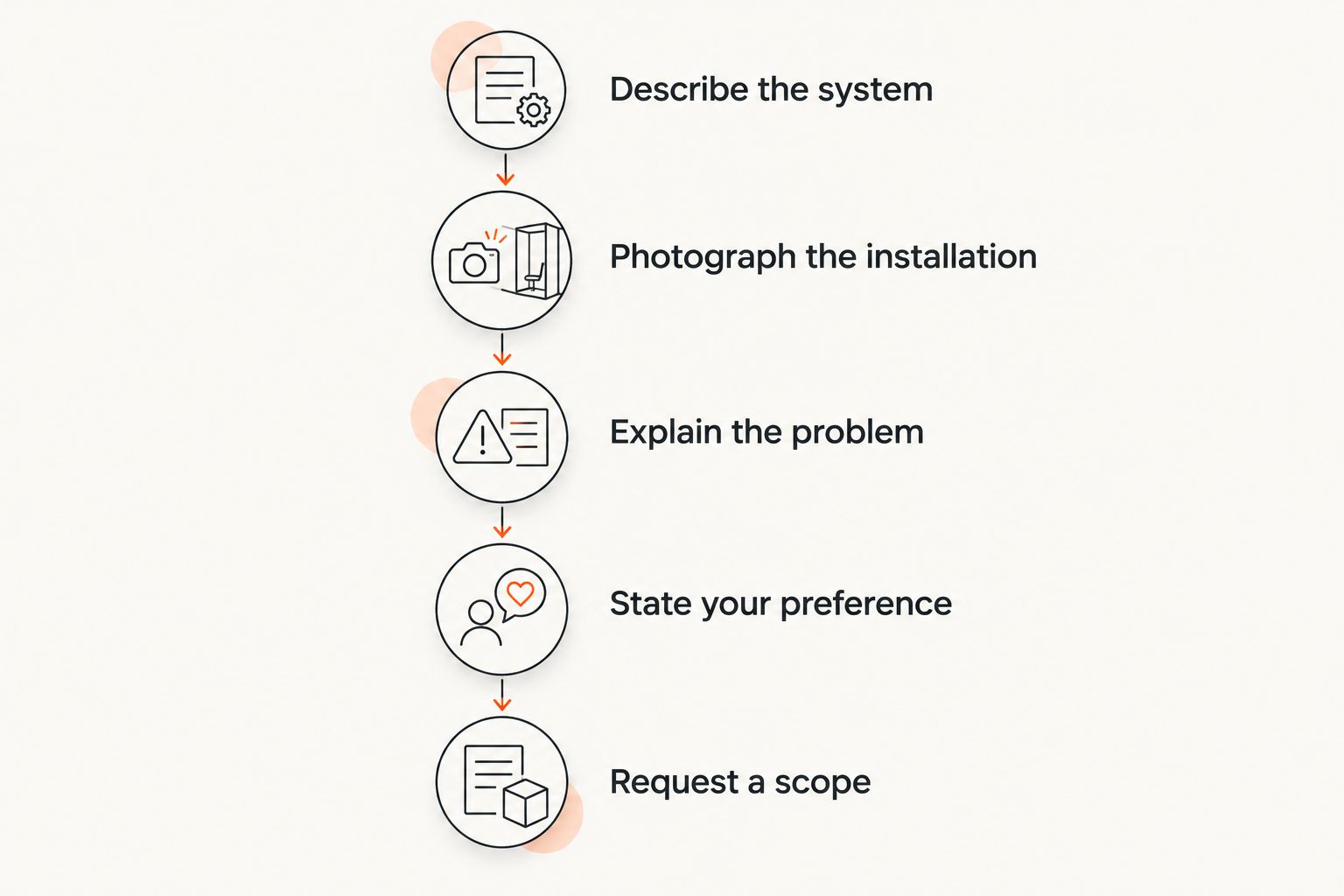
- Describe the system. Say whether you are replacing a wall-mounted split system or another arrangement. Include the existing model details if you can read them safely.
- Photograph the installation. Show the indoor unit, outdoor unit, visible pipe covers, drain route and surrounding access. Include readable equipment labels where accessible.
- Explain the problem. Mention leaks, faults, unusual noise or a diagnosis already provided. Do not label the cause unless it has been confirmed.
- State your preference. Say whether you prefer the same locations and want suitable fittings assessed for reuse.
- Request a written scope. Ask for retained parts, replacement parts, removal, electrical work and repair exclusions to be identified.
Use a brief such as: Replace the existing wall-mounted split system, preferably in the same locations. Please assess the existing pipework, drain, supports and electrical supply for reuse, and identify any replacement work, removal and wall repairs in the quote.
When you post on QuickQuote, posting is free, there is no connection fee, and you choose who to hire. You can receive quotes from up to three local tradies; that limit is not a guarantee of three responses.
What should my replacement quote say before I accept it?
Your 2026 quote should identify the replacement equipment and explain the installation scope in terms you can check. Ask for written clarification where the quote relies on existing fittings passing inspection.
Use these checks before accepting:
- Equipment: the specified indoor and outdoor equipment, not just a general description.
- Retained components: which pipes, drains, supports and electrical components are intended to stay.
- Checks and conditions: what the installer will inspect or test before confirming reuse.
- Replacement work: what happens if a retained component proves unsuitable.
- Completion: commissioning, operating instructions and any required documentation.
- Removal: decommissioning and taking away the old equipment.
- Repairs: sealing, patching, painting and other work included or excluded.
Agree how variations will be approved before work starts. A condition such as subject to pipework suitability should explain the decision process, not leave you guessing what happens next.
Can keeping the old fittings reduce installation work?
Keeping suitable fittings reduces the components that need replacing, but inspection, preparation and testing still form part of the job. Ask the installer to explain the retained-work scope rather than assuming reuse makes the installation straightforward.
Compare a reuse proposal with a replacement proposal only after identifying the difference in scope. Neither approach is automatically right for every home.
Should I insist on new pipework for a replacement?
Do not insist on either new or reused pipework before the installer checks the equipment requirements and existing condition. Ask for the reason behind the recommendation and any manufacturer conditions that apply.
If the explanations differ between quotes, ask each installer to address the same existing pipe run and replacement model. That makes the disagreement specific enough to resolve.
FAQ
Can I reuse the copper pipes when replacing my air conditioner?
Existing copper pipes can be reused only when the installer confirms their specification and condition suit the replacement system and its manufacturer’s requirements. Ask the quote to state the checks, preparation and conditions involved.
Does a replacement air conditioner need new wiring?
A replacement air conditioner does not automatically need new wiring, but the existing electrical installation needs assessment against the new equipment’s requirements. Have an appropriately licensed person confirm the work required.
Can the new outdoor unit use the old brackets?
The new outdoor unit can use existing brackets only if their condition, capacity, fixings and arrangement suit the equipment. The installer also needs to check the required clearances.
What affects air conditioning installation cost when replacing an old unit?
Air conditioning installation cost depends on the equipment and the work required around it, including pipework, drainage, electrical suitability, access and removal. Compare quotes with the same inclusions and reuse assumptions.
Do I need a site inspection before accepting a replacement quote?
A site inspection is needed when the installer cannot confirm important conditions from the information supplied. Ask which parts of a photo-based quote remain conditional and how changes will be approved.
Will the installer take away my old air conditioner?
Removal is included only when the agreed scope says so. Ask the quote to cover decommissioning and taking away the old indoor and outdoor equipment, as well as any unwanted fittings.
Can I use QuickQuote to compare replacement installation quotes?
QuickQuote lets you post a home-service job for free and receive quotes from up to three local tradies, with no connection fee. You choose who to hire; the marketplace does not perform the installation.
One last thing
Ask the installer to record what stayed, not just what was installed. A completion record that identifies retained pipework, drains and supports gives you a clearer account of the finished job than a model number alone.
Keep that record with your 2026 quote, equipment details and installation documents. If a problem arises later, you can explain which components were replaced without relying on memory.
Related guides

Connecting homeowners with trusted local tradies. Made in Sydney.