
Air conditioning quotes: back-to-back or a longer pipe run?
Compare air conditioning installation cost by pipe route, drainage and electrical work. Check back-to-back and longer-run quotes before choosing a tradie.
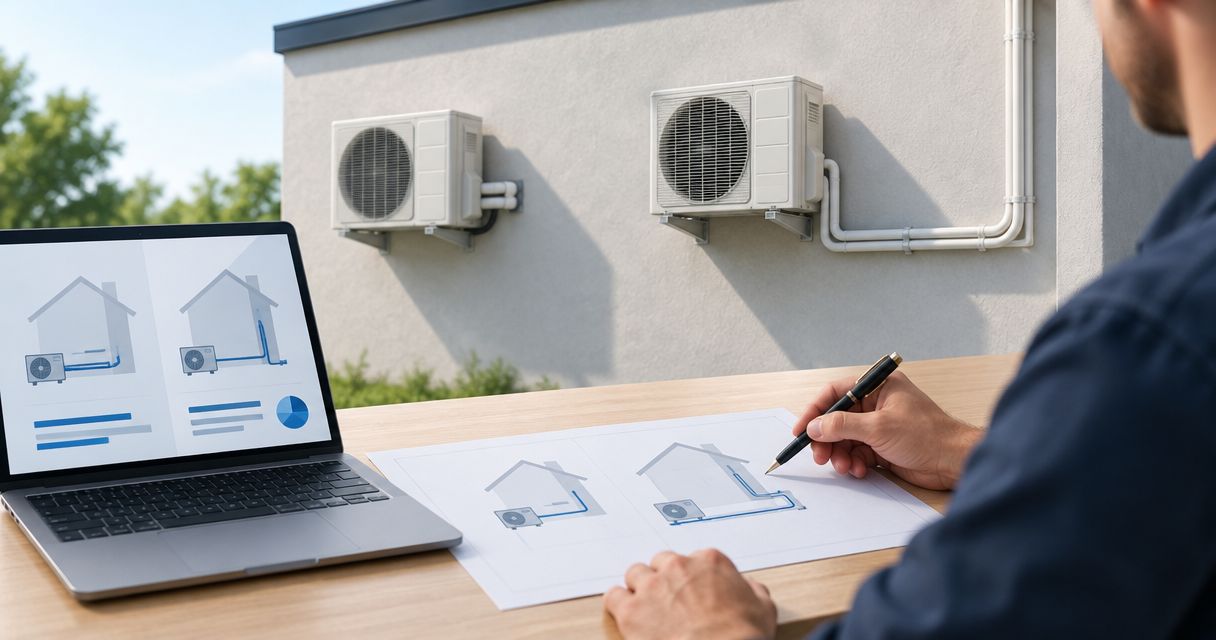
A back-to-back installation puts the indoor and outdoor units close together, usually on opposite sides of the same wall; a longer pipe run places them farther apart. For air conditioning installation cost, compare the proposed route and written inclusions, not just the installation label. A short route does not automatically include electrical work, drainage, mounting or removal of an old unit, so make those items explicit in your 2026 quotes.
TL;DR- Compare air conditioning installation cost using the same unit locations, pipe route and electrical scope.
- Back-to-back suits nearby unit locations; a longer pipe run gives more placement flexibility but needs a defined route.
- QuickQuote suits homeowners wanting quotes from up to three local tradies, with control over who they hire.
- Ask each installer to list drainage, mounting, electrical work and exclusions before accepting a quote.
Why this matters
Two quotes can describe the same air conditioner but cover different installation jobs. One installer might allow for an outdoor unit directly behind the indoor unit, while another has allowed for a route around a corner.
Agree on the layout before comparing the totals. Then use the guide to air conditioning installation quotes and extras to check what sits outside the installation allowance.
Air conditioning quotes: back-to-back or a longer pipe run?
Back-to-back describes the relative position of the indoor and outdoor units. It does not describe every part of the installation. A longer pipe run means the refrigerant pipes travel farther between the units, with the actual route determined by the property and the equipment's installation requirements.
For a split-system quote, ask the installer to identify both locations and explain how the connecting services will travel between them.
| Check | Back-to-back installation | Longer pipe run |
|---|---|---|
| Best for | Suitable indoor and outdoor positions close together | A preferred or suitable outdoor position farther away |
| Main advantage | A more direct connection between units | More flexibility over outdoor-unit placement |
| Main limitation | The nearby outdoor position still needs to be suitable | More routing, covering and access details to resolve |
| Pipework question | What route and pipe length are included? | What complete route and pipe length are included? |
| Drainage question | Where will indoor condensate discharge? | Can condensate drain along the proposed route? |
| Quote check | Confirm electrical work and mounting separately | Confirm added pipework, access and finishing separately |
Neither layout removes the need to check clearances, servicing access and drainage. Choose a suitable layout first, then compare quotes for that same layout. A shorter route is not a good saving if the equipment ends up in an unsuitable position.
Back-to-back: a direct route, not a complete scope
A back-to-back arrangement usually places the outdoor unit near the indoor unit on the other side of an external wall. This can keep the connecting route straightforward, provided the wall and outdoor position are suitable.
The limitation is placement. The indoor location that suits the room does not automatically line up with an outdoor location that has adequate airflow, access and clearance.
Before accepting a back-to-back quote, confirm:
- The exact indoor wall and outdoor position.
- Whether the outdoor unit will sit on a base or wall brackets.
- The included refrigerant pipe route and length.
- Where the condensate drain will finish.
- What electrical work is included.
- Who seals the wall penetration and finishes the visible covering.
Do not rely on the word ‘standard’ to answer these questions. Ask the installer to attach the scope to your quote, especially if the initial estimate was based on photos rather than a site inspection.
Longer pipe run: more placement flexibility, more detail to agree
A longer route can separate the best indoor position from the best outdoor position. That is useful when the space directly behind the indoor unit is unsuitable or conflicts with how you use the property.
The trade-off is a more involved route. Pipes might need to travel along an external wall, around a corner or through an accessible building space. Each proposed route needs assessment rather than an assumption that the pipes can simply go anywhere.
Ask the installer to mark the route on a photo or sketch. The marked route should show visible sections, penetrations and the outdoor-unit position, not just a line between the units.
Confirm that the proposed pipe length and height difference comply with the selected equipment's installation instructions. Also ask whether that route requires additional refrigerant and whether any required work is included.
Approve the route as well as the unit locations. A quote that says ‘additional pipework included’ still leaves room for disagreement about where that pipework will appear.
Why air conditioning installation cost varies
For your 2026 comparison, separate the equipment being supplied from the work needed to install it. These scope differences explain why quotes for apparently similar jobs are not always directly comparable.
- Pipe route: A route around corners or through building spaces involves different work from a direct wall connection. Ask what route has actually been allowed for.
- Access: Height, restricted working space and difficult access affect how the installer carries out the job. Describe those conditions before requesting quotes.
- Electrical work: The existing electrical arrangement needs assessment. Ask whether the quote includes the required circuit work, isolation and any switchboard work identified for your installation.
- Drainage: Condensate needs a suitable discharge arrangement. Confirm whether the proposed layout uses gravity drainage or requires a pump, and what is included.
- Mounting and finishing: Bases, brackets, pipe covering, wall penetrations and sealing are separate details worth naming. Ask who handles any patching or painting outside the installation scope.
- Existing equipment: Removing an old system, dealing with its refrigerant and taking equipment away should be stated explicitly. Do not assume replacement means removal is included.
These are scope checks, not reasons to accept unexplained extras. Ask the tradie to connect each additional item to a specific condition at your home.
How do you describe the job so quotes match?
Give every installer the same starting information. Your 2026 job description should explain the layout you want while leaving technical suitability for the installer to confirm.
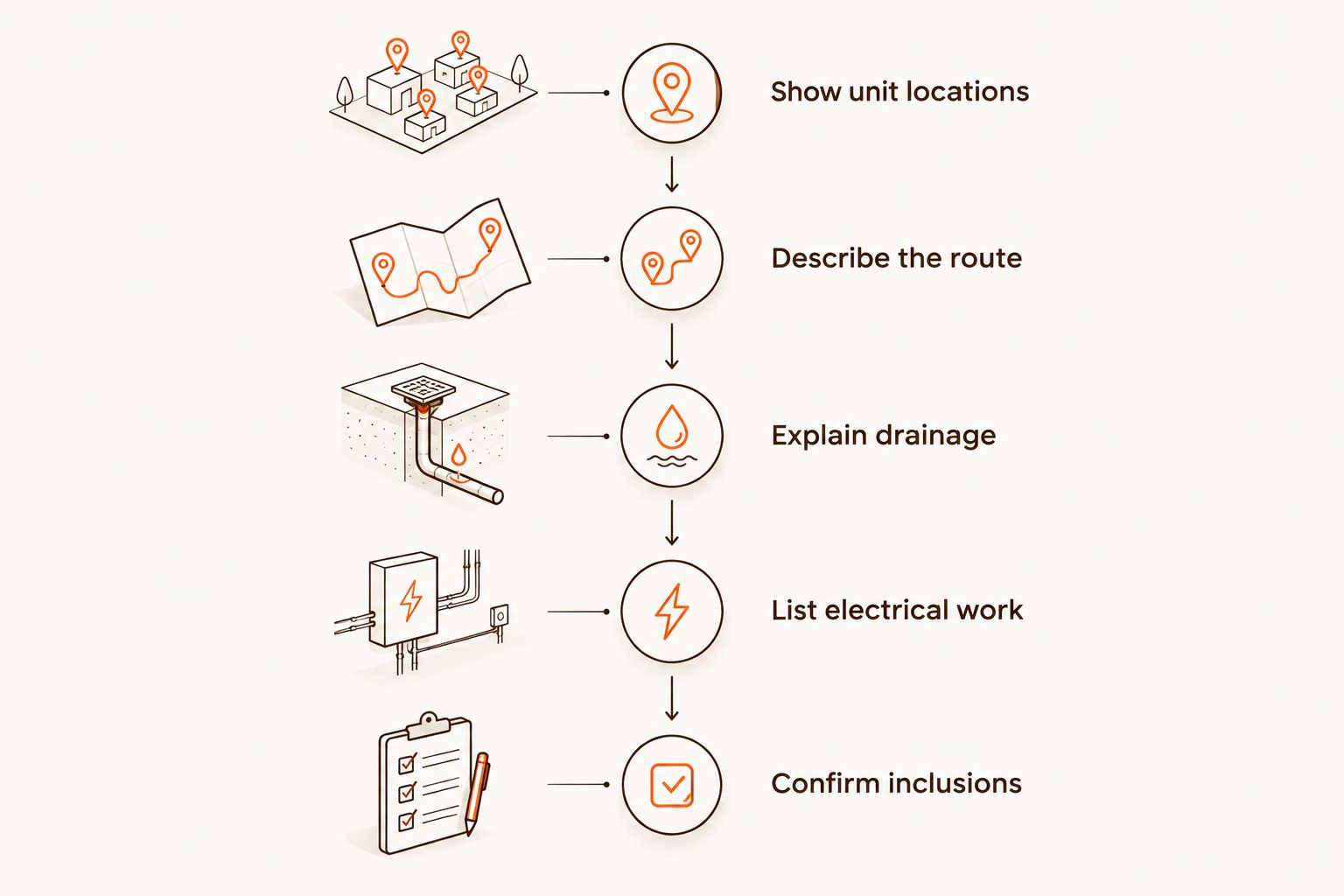
- Show unit locations. Photograph the proposed indoor wall and outdoor area. Include wider views so the installer can see nearby doors, windows, fences and access restrictions.
- Describe the route. Say whether you expect a back-to-back installation or a longer route. Mention corners, upstairs rooms and building spaces the route might cross.
- Explain drainage. Show the ground or discharge area near the proposed outdoor location. Ask the installer to confirm a suitable condensate arrangement.
- List electrical work. Explain whether this is a new installation or a replacement. Provide requested switchboard photos without removing covers or touching electrical components.
- Confirm inclusions. Request a written list covering mounting, pipework, drainage, electrical work, finishing and any old-system removal.
Keep photos current and clear. Do not climb onto a roof or open electrical equipment to improve a job description; explain inaccessible areas and let the installer arrange a safe assessment.
A job description you can adapt
Use plain language rather than trying to specify technical work yourself:
‘I'm seeking quotes for a split-system air conditioner. My preferred indoor position is on the living-room external wall. The outdoor position needs assessment because the space directly behind that wall is a walkway. Please confirm the pipe route, mounting, drainage, electrical work and any finishing exclusions. Photos show both areas and the access path.’
For a replacement, add whether you want the existing equipment removed and taken away. If you have already selected equipment, give its exact model rather than describing it only by room size.
QuickQuote is best for homeowners who want a quote-matching marketplace connecting them with up to three local tradies. It is free to post on QuickQuote, there is no connection fee, and you choose who to hire. The marketplace does not carry out the installation; confirm technical details and the final scope with the tradie.
Post your air conditioning job
QuickQuote is free to post, with no connection fee. Receive quotes from up to three local tradies.
Post your jobIs back-to-back always the better installation?
Back-to-back is better only when both nearby unit positions are suitable. A direct pipe route is useful, but it does not outweigh the equipment's clearance requirements, outdoor airflow or access for servicing.
If an installer recommends a different location, ask what problem it solves. Get the revised route and scope in writing before deciding.
Does a longer pipe run include the electrical work?
A longer pipe run does not automatically include electrical work. Refrigerant pipework and the electrical installation are separate scope items, even when one business arranges both.
Ask who will perform the electrical work and what the quote includes. If switchboard work is identified, have it described rather than buried under a general installation allowance.
What should you check before accepting the quote?
Read the installation description beside the photos or sketch you supplied. Check that the quoted layout is the one you discussed, not a different arrangement assumed during quoting.
Look for a clear equipment description and separate wording for the installation scope. Confirm the route, mounting, drainage, electrical work, old-system removal and exclusions. Ask whether the quote remains subject to a site inspection.
Resolve unclear allowances before accepting. If extra work is discovered, agree on its scope and how the change will be approved before that work proceeds. A written variation is easier to check than a conversation remembered differently.
Also confirm the installer holds the licences required for the work being performed. Refrigerant handling and electrical work have their own licensing requirements; a marketplace listing is not a substitute for checking the people doing your job.
FAQ
What does back-to-back air conditioning installation mean?
Back-to-back usually means the indoor and outdoor units sit close together on opposite sides of the same external wall. It describes the layout, not every inclusion in the installation quote.
What should an air conditioning installation cost comparison include in 2026?
An air conditioning installation cost comparison in 2026 should use the same equipment, unit locations and installation scope. Check pipework, drainage, electrical work, mounting, finishing and old-system removal separately.
Is a longer pipe run bad for an air conditioner?
A longer pipe run is not automatically unsuitable. The installer must check the selected equipment's permitted pipe length, height difference and installation requirements before confirming the route.
How much pipework comes with a standard installation?
The included pipework is whatever the installer states in the written quote. Ask for the included length and route rather than treating ‘standard installation’ as a fixed scope.
Can I put the outdoor unit somewhere other than behind the indoor unit?
A different outdoor location needs assessment against the equipment's requirements and the property's layout. Ask the installer to confirm the route, airflow, clearances, drainage and service access before agreeing.
Do I need a condensate pump for a longer pipe run?
A longer refrigerant pipe run does not by itself establish whether you need a condensate pump. The installer needs to assess the indoor unit's drain route and whether gravity drainage is suitable.
Does posting on QuickQuote commit me to hiring someone?
You choose who to hire through QuickQuote. It is free to post, there is no connection fee, and your job can receive quotes from up to three local tradies rather than a guaranteed three responses.
One last thing
The shortest pipe route and the simplest drain route are not necessarily the same. Refrigerant pipes connect the units, while condensate still needs a suitable discharge arrangement. Ask the installer to explain both routes on the same sketch.
Before accepting your 2026 quote, save that sketch with the written scope. It gives you a concrete reference if the proposed outdoor location or visible pipe covering changes before installation.
Related guides

Connecting homeowners with trusted local tradies. Made in Sydney.