
Air conditioning quotes: how to compare split and ducted systems
Compare air conditioning installation cost by scope, not just the total. Check split and ducted quotes, electrical work, exclusions and handover details.
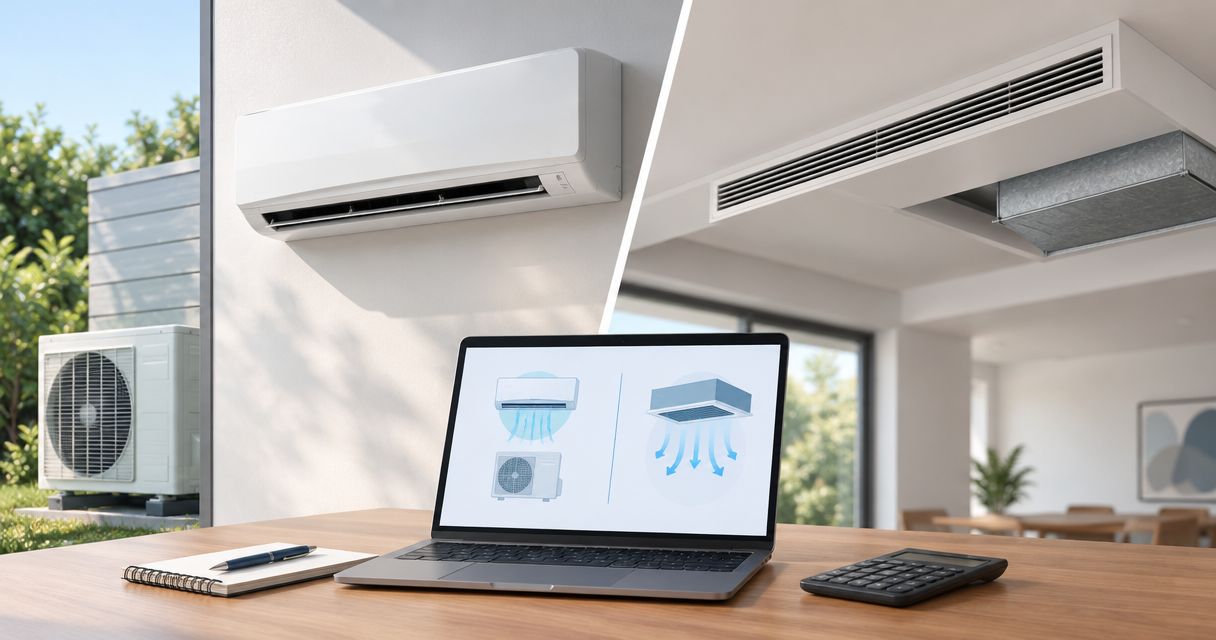
Air conditioning installation cost depends on the system, the rooms you want to condition and the work needed to fit it to your home. Compare split and ducted quotes against the same room coverage and installation scope, then check electrical work, drainage, access and removal separately before accepting a total.
TL;DR- Compare air conditioning installation cost against room coverage, electrical work and installation inclusions, not the total alone.
- Split systems suit individual rooms; ducted systems suit homes needing air delivered through ceiling or floor outlets.
- QuickQuote suits homeowners seeking air conditioning quotes: posting is free, with quotes from up to three local tradies.
- Ask for written exclusions and a clear approval process for extra work before choosing an installer.
Why this matters
A split-system quote for a living room and a ducted quote for several rooms do not cover the same job. The total tells you little until you know which spaces each proposal serves and what the installer has allowed for.
For a 2026 installation, start with your room requirements rather than a preferred equipment size. Read the guide to air conditioning installation extras alongside each quote so you can separate equipment supply from the work around it.
Choose the quote that clearly covers your job, not the one with the shortest description. An unexplained exclusion leaves you with a question to resolve before booking.
Air conditioning quotes: how do you compare split and ducted systems?
Compare split and ducted systems by coverage, installation work and how you intend to use the rooms. Ask each installer to explain the proposed layout and equipment selection against the same brief.
The table below shows the practical differences. It does not replace a site assessment: roof access, room layout and outdoor-unit placement still need checking at your property.
| Check | Split system | Ducted system |
|---|---|---|
| Best for | Conditioning an individual room or defined area | Serving several rooms through a duct network |
| Indoor arrangement | A room unit, commonly mounted on a wall | A concealed indoor unit connected to outlets by ducts |
| Main advantage | Room-by-room installation without a whole-home duct network | Air distribution to several rooms without wall units in each room |
| Main limitation | A single room unit does not provide separately controlled air delivery to every room | Needs suitable space and access for the indoor unit, ducts and outlets |
| Installation checks | Wall position, pipe route, drain route and outdoor-unit position | Duct routes, outlet layout, return-air position, zones and service access |
| Controls to confirm | Controller functions and any separately specified connectivity | Which zones are included and what each zone controls |
| Quote detail needed | Exact model, capacity and connection scope | Exact model, capacity, duct layout, outlets, zones and connection scope |
Do not accept a comparison based only on equipment capacity in kilowatts. Capacity describes heating or cooling output; it does not tell you whether pipework, wiring, ducting or removal is included.
Split systems: best for individual rooms
A split system suits a homeowner who wants to condition a particular room or defined area. Its practical advantage is a focused installation without distributing air through ducts across the house.
The limitation is coverage. An installer needs to explain what the proposed unit will serve rather than treating an open doorway as proof that adjoining rooms will be comfortable.
Ask the installer to mark the indoor and outdoor positions and describe the connecting route. A back-to-back arrangement places the units on opposite sides of a wall; a different outdoor position needs a route that the quote should identify.
Before accepting a split-system quote, check:
- Equipment: the exact indoor and outdoor model references and proposed capacity.
- Connections: what pipework, wiring, drainage and wall penetrations are included.
- Positioning: where the unit blows air and how the outdoor unit remains accessible.
- Finishing: whether covers, mounting supports and making good are included.
- Replacement work: whether the existing unit is disconnected, removed and taken away.
Choose a split system when the proposed room coverage matches your actual needs. If you want several closed bedrooms conditioned, ask for a proposal that explicitly addresses each bedroom.
Ducted systems: best for several rooms with suitable installation space
Ducted air conditioning suits homeowners seeking air delivery to several rooms through a planned duct network. Its advantage is the ability to serve those rooms without a wall-mounted indoor unit in each space.
The limitation is the installation space it needs. The indoor unit, ducts, return-air path and service access must fit the property, so a room list alone is not a complete installation plan.
For your 2026 quote, ask for a marked layout showing outlets, the return-air grille and the proposed zones. Confirm which rooms belong to each zone and what happens when you select different combinations.
Check whether the proposal includes:
- Duct supply and installation, rather than equipment supply alone.
- Outlet locations and any choices you need to approve.
- Zone controls and the rooms assigned to them.
- Access for filter cleaning and equipment servicing.
- Ceiling penetrations, access alterations and making good.
- An assessment of existing ducts if the installer proposes reusing them.
Choose ducted air conditioning only after the installer explains the layout and access requirements. Do not assume that an existing duct network is suitable for replacement equipment simply because it is already there.
Why air conditioning installation cost varies
The useful question is what changes between your property and the installation described in the quote. These factors belong in the written scope, not in a conversation you have to remember later.
- Room coverage: conditioning a single room is a different brief from supplying several rooms. List the spaces you expect the system to serve.
- Equipment selection: the model, capacity and control functions define what is being supplied. Ask the installer to explain the selection.
- Connection routes: pipework, drains and cabling need identified routes. A difficult route needs a clear allowance or exclusion.
- Electrical work: confirm the circuit and switchboard work included. Keep any required changes visible rather than assuming they form part of installation.
- Physical access: roof access, wall construction, mounting positions and work at height affect how the installer can complete the job.
- Removal and finishing: disconnecting old equipment, taking it away, repairing openings and repainting are separate scope questions.
An unexplained difference between quotes is a reason to ask questions. It is not evidence that an installer has included more work, selected better equipment or made a mistake.
How to prepare a clear air conditioning job brief
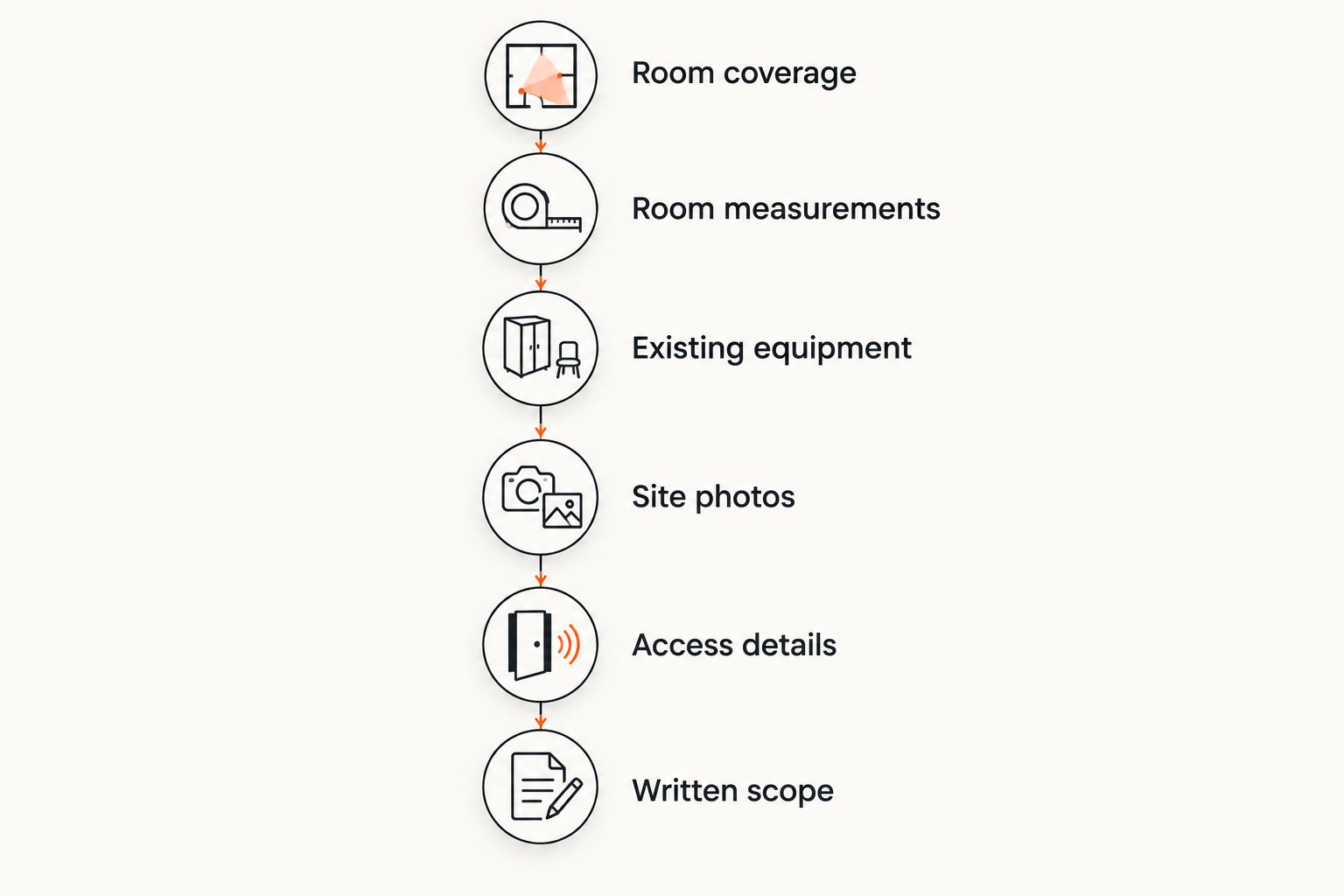
Give every installer the same starting information. These 6 checks help you describe the job without trying to design the system yourself.
- Room coverage: list the rooms you want heated and cooled. Explain whether doors stay open or closed and whether rooms are used together.
- Room measurements: provide room dimensions and ceiling heights where you can measure safely. Note large windows and the direction they face.
- Existing equipment: photograph accessible model labels and show where the current indoor and outdoor units sit. Say whether replacement and removal are part of the job.
- Site photos: show proposed indoor positions, outdoor areas and accessible routes. Photograph from ground level; leave roof spaces and electrical enclosures to the installer.
- Access details: describe stairs, narrow side passages, locked gates and any known restrictions on outdoor-unit placement.
- Written scope: ask for equipment details, installation inclusions, exclusions and the checks needed before the quote is confirmed.
Keep your brief factual. If you do not know the roof-space clearance or electrical capacity, ask the installer to assess it rather than entering a guess.
QuickQuote is an air conditioning quote-matching marketplace for homeowners who want to compare local tradies and choose who to hire. Posting is free, there is no connection fee, and you can receive quotes from up to three local tradies; that limit is not a promise of three responses.
Post your air conditioning job
Free to post. Receive quotes from up to three local tradies. You choose who to hire.
Post your jobWhat should you check before accepting a quote?
For a 2026 booking, keep the quote, agreed layout and written clarifications together. A clear scope gives you something concrete to refer to if the proposed work changes.
Confirm the supplied equipment
Check the exact model references rather than accepting a brand name alone. Ask whether controllers, zone components and other described accessories are included in the supply scope.
If an installer proposes a substitute, request the revised model details before agreeing. Recheck the capacity, controls and installation requirements instead of assuming the alternative is identical.
Separate included work from assumptions
Look for phrases such as standard installation or electrical work excluded. Ask the installer to explain those phrases in terms of your property, including what needs inspection before the scope can be confirmed.
For ducted work, ask who handles any access opening or ceiling repair. For split systems, confirm the pipe and drain routes and whether visible covers are included.
Agree how changes get approved
Ask the installer to describe any extra work before starting it and obtain your written approval. The explanation should identify the reason for the change and its effect on the agreed job.
Keep optional work separate from work needed to complete the installation. You should be able to tell what you can decline and what must be resolved before the system can operate.
Check credentials and handover
Ask who will perform the electrical and refrigerant work and verify the relevant credentials for the work in your state or territory. Also confirm insurance and who handles questions about the installation afterwards.
Request a handover that covers the controls, filter access and routine care. Ask what installation paperwork and manufacturer documents you will receive, and distinguish equipment warranty terms from the installer's workmanship terms.
Is a split system better than ducted air conditioning?
A split system is better matched to individual-room conditioning; ducted air conditioning is better matched to a planned network serving several rooms. Neither arrangement wins without reference to your layout, room use and installation access.
For a 2026 decision, write down which rooms need conditioning at the same time. That gives the installer a useful design brief instead of asking for a whole-home solution when your main need is one living area.
Should you get several air conditioning quotes?
Several air conditioning quotes help you compare equipment choices, installation scope and exclusions. They are useful only when the installers are answering the same brief.
QuickQuote lets you post an air conditioning job for free and receive quotes from up to three local tradies, with no connection fee. You choose who to hire; compare the written scope before making that choice.
FAQ
What determines air conditioning installation cost?
Air conditioning installation cost depends on room coverage, equipment selection and the work needed at your property. Compare electrical work, connection routes, access, removal and finishing as separate parts of the scope.
Is ducted air conditioning better for every home?
Ducted air conditioning is not the best fit for every home. It needs suitable installation space and a layout that matches the rooms you want to condition; a split system can suit an individual-room job.
Does an air conditioning quote include electrical work?
Electrical work is included only to the extent stated in the quote. Ask the installer to identify the circuit work, switchboard assessment and any exclusions before you accept.
Can I keep my old ducts when replacing ducted air conditioning?
Reusing old ducts needs an assessment of their condition and suitability for the proposed system. Ask the installer to state what will be inspected, reused and replaced in the written quote.
What photos should I send an air conditioning installer?
Send photos of accessible equipment labels, proposed unit positions, outdoor access and visible connection routes. Stay at ground level and leave roof-space and electrical inspections to the installer.
Does QuickQuote install the air conditioner?
QuickQuote is a quote-matching marketplace, not the contractor carrying out the installation. You post your job for free, can receive quotes from up to three local tradies and choose who to hire.
What should I ask before booking an installer in 2026?
Before booking an installer in 2026, confirm the exact equipment, written scope, exclusions, credentials and approval process for changes. Ask what testing, paperwork and instruction are included at handover.
One last thing
Ask where the filter will be cleaned before approving the layout. A plan that shows equipment and outlets but ignores routine access leaves an everyday task unresolved.
Have the installer point out filter access and service access on the proposed layout. It is a simple check to complete before positions are agreed.
Related guides

Connecting homeowners with trusted local tradies. Made in Sydney.