
Rubbish removal quotes: how are volume and disposal priced?
Compare rubbish removal cost by volume, loading and disposal. Check quote inclusions, describe your load clearly and agree on changes before collection starts.

Rubbish removal cost depends on the space your load takes up, the material being removed, the work needed to collect it and the disposal arrangements. For a 2026 quote, ask whether the total includes loading, transport, disposal and GST, and how the amount will change if the collected load differs from your description.
TL;DR- Compare rubbish removal cost using the same item list, access details and disposal inclusions.
- A cubic metre measures space, not weight; identify dense materials separately.
- Ask whether loading, transport, disposal and GST are included before accepting a quote.
- QuickQuote suits homeowners who want to compare rubbish removal quotes and choose who to hire.
Rubbish removal quotes: how are volume and disposal priced?
Separate the size of the load from the work and disposal needed to remove it. A volume estimate alone does not describe a complete rubbish removal job. The quote also needs to identify the materials, collection point and any exclusions.
You can post your job on QuickQuote for free and receive quotes from up to three local tradies. There is no connection fee, and you choose who to hire. Use the same description for each quote so you compare the same work.
A quote can use one or several of the following charging methods. Ask the tradie which applies rather than assuming every business measures a load the same way.
| Quote basis | Best for understanding | What it makes clear | What still needs checking |
|---|---|---|---|
| Volume in cubic metres | How much space the rubbish occupies | The estimated load size | Packing method, weight restrictions and excluded materials |
| A fraction of a truck | A share of a named vehicle's capacity | The proposed share of the load space | Usable capacity in cubic metres and how the fraction is assessed |
| Item-based removal | A clearly identified item | What object the quote covers | Carrying, dismantling and disposal inclusions |
| Labour plus disposal | Collection work and disposal charged separately | Which parts are measured separately | How labour is recorded and disposal charges are evidenced |
| A fixed total for the described job | A complete, agreed scope | The total for the stated work | Assumptions and the process for approving changes |
No method removes the need for a clear scope. An item-based quote becomes hard to compare if one tradie includes carrying furniture downstairs and another assumes everything is at the kerb.
Why this matters
A short description such as “garage rubbish” leaves too much open. It does not tell a tradie whether the load is empty cardboard, old furniture, renovation rubble or a mixture.
That uncertainty matters when you compare totals. A lower quote is not a better deal if it leaves out work another quote includes. Check the written scope before you decide who to hire.
For a 2026 collection, keep a copy of the accepted quote and the photos used to prepare it. These give you a clear reference if the collector says the job is different on arrival.
How is rubbish volume measured?
A cubic metre is a measure of space. One cubic metre, written as 1 m³, is the volume of a cube measuring 1 metre long, 1 metre wide and 1 metre high. It does not indicate how heavy the contents are.
For a roughly rectangular pile, measure its length, width and height in metres, then multiply those dimensions. A pile measuring 2 metres by 1 metre by 1 metre occupies a rectangular space of 2 m³. That is a measurement example, not a removal quote or a guarantee of chargeable volume.
Loose branches, chairs and irregular objects leave gaps. A pile's outside dimensions therefore do not tell you exactly how a collector will pack or assess it.
Ask these questions:
- Is the quote based on the pile as shown or its volume after loading?
- Will furniture be dismantled, and is that work included?
- What happens if the collector assesses a larger load on arrival?
- Can the collector confirm the total before loading starts?
Do not compress, break or handle unsafe materials just to reduce a volume estimate. Describe them and ask how they should be managed.
What does a truck fraction actually tell you?
A half-truck quote tells you little unless you know the usable load capacity. Half of one vehicle is not necessarily the same volume as half of another.
Ask for the quoted fraction to be explained in cubic metres, or ask the collector to identify exactly which photographed items it covers. Both approaches make the scope easier to check than an unexplained truck fraction.
Compare the rubbish covered, not just the truck fraction. Also check whether the quote assumes a particular loading height or excludes dense materials. A vehicle has weight limits as well as a limited amount of space.
How are disposal charges handled?
Disposal can be included in the quoted total or listed separately. Ask which arrangement applies and whether the amount is fixed for the described load or adjusted against the receiving facility's charge.
The material matters. Bricks, soil and concrete are dense; an equal volume of empty packaging does not weigh the same. Mixed materials also need to be described so the collector can confirm the appropriate disposal arrangements.
Ask the collector to confirm:
- Which waste types the quote includes.
- Which items need separate handling or assessment.
- Whether disposal is included in the total.
- How any variable disposal charge will be calculated.
- Whether supporting disposal documentation will be provided.
Do not assume a general rubbish quote covers asbestos, chemicals, gas cylinders or other potentially hazardous materials. Identify suspected hazards before booking and seek appropriate handling advice. Never put unidentified material into a mixed load to avoid discussing it.
Why rubbish removal cost varies
For your 2026 comparison, give every tradie the same information about these factors. They explain the job more clearly than a photo of a closed garage door.
- Load volume: List the items and show the whole pile, including anything behind larger objects.
- Material and weight: Separate furniture, packaging, green waste and dense building materials in your description.
- Access: State whether collection involves stairs, a lift, narrow passages or a long carry to the vehicle.
- Collection work: Explain whether items need dismantling, bagging or gathering from different areas.
- Disposal arrangements: Identify materials needing separate assessment and ask what the total includes.
- Scope boundaries: Say whether you want removal only or additional sweeping and cleaning.
These are details to disclose, not automatic extra charges. The collector should explain which affect your particular quote.
How do you prepare a rubbish removal job for quoting?
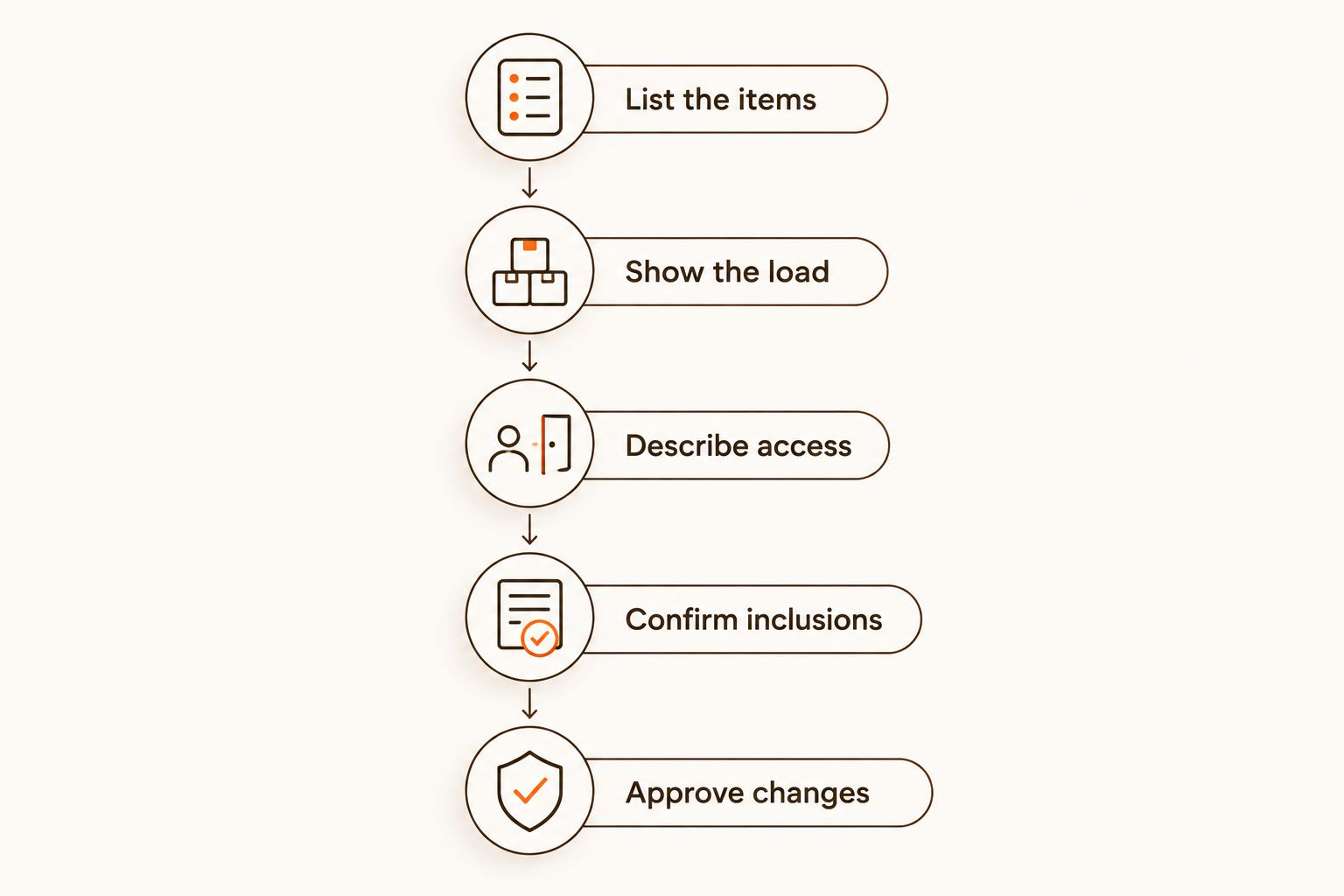
List the items
Write an inventory in ordinary language. Name bulky objects individually, then describe smaller loose materials by type and approximate extent. Avoid relying on “a few bits” or “general junk”.
Mention whether cupboards or containers still hold rubbish. A photo of the outside does not show their contents, and those contents change the collection scope.
Show the load
Take a wide photo that shows the whole pile, then closer photos of items that are difficult to identify. Include rough dimensions for bulky objects and the pile where practical.
If rubbish is spread across several areas, say so. Do not let photos of the same items from different angles look like separate piles; label them clearly in your description.
Describe access
Explain where the rubbish sits and where the collection vehicle can stop. Include stairs, gates, lift access and any building booking requirements you already know about.
State who will move the rubbish to the collection point. A quote for kerbside pickup is a different scope from carrying everything out of an upstairs room.
Confirm inclusions
Ask for loading, transport, disposal and GST to be addressed in writing. Add any work you need beyond collection, such as dismantling a large item or sweeping the cleared area.
Also ask what is excluded. An explicit exclusion is easier to deal with before booking than an assumption discovered halfway through loading.
Approve changes
Agree on the process if the actual load differs from the description. Ask the collector to explain the difference and confirm the revised total before starting additional work.
Do not treat a changed scope as an open-ended authorisation. You should know what extra work is proposed before you agree to it.
What should you put in your job description?
Use the following structure for a 2026 rubbish removal job. Replace each instruction with your actual details rather than copying an estimate you have not checked.
- Items: Name the furniture, bags, loose materials and other rubbish to be collected.
- Size: Give approximate dimensions and attach photos showing the full load.
- Materials: Identify green waste, timber, metal, rubble or other contents separately.
- Location: State whether the rubbish is indoors, outdoors, upstairs or already at the collection point.
- Access: Describe gates, stairs, lift arrangements and the distance to vehicle access.
- Work required: State who handles carrying, dismantling and any requested clean-up.
- Quote request: Ask for a total that identifies loading, transport, disposal, GST and exclusions.
- Changes: Ask how a different load size or unexpected material will be assessed before work begins.
QuickQuote is a quote-matching marketplace, not the contractor collecting your rubbish. Posting is free, with no connection fee; you can receive quotes from up to three local tradies and decide who to hire. The limit is not a promise that three tradies will respond.
Describe your rubbish removal job
Free to post, no connection fee, and you choose who to hire.
Post your jobHow do you compare quotes before accepting one?
Read each quote against your item list, not just against the other totals. Check that the same rubbish, collection point and carrying work appear in every scope.
Then check what happens at the boundaries. Does the quote stop at removing the listed items, or does it also include sweeping? Does it include dismantling, or must you arrange that first? Ask for unclear answers to be written into the quote.
Keep removal separate from other jobs unless the quote expressly combines them. Taking away unwanted furniture does not, by itself, describe a room clean or repair work left behind after collection.
Accept a clear scope with a clear change process. If a collector cannot explain the volume allowance or disposal treatment, resolve that before agreeing to the job.
FAQ
How do I compare rubbish removal cost in 2026?
Compare rubbish removal cost using the same item list, photos, access details and inclusions. Ask each collector to identify loading, transport, disposal, GST and the process for changes.
What does one cubic metre of rubbish mean?
One cubic metre is the space inside a cube measuring 1 metre long, 1 metre wide and 1 metre high. It measures volume, not weight, and does not establish the removal charge on its own.
Is a half-truck rubbish removal quote enough detail?
A half-truck quote needs a stated capacity or a clear list of the items it covers. Ask how the collector assesses the fraction and whether weight or material exclusions apply.
Are disposal charges included in rubbish removal quotes?
Check the individual quote to establish whether disposal is included or charged separately. If it varies, ask how the charge is calculated and what documentation you will receive.
Will carrying rubbish downstairs be included?
Carrying rubbish downstairs is included only when it forms part of the agreed scope. Describe the stairs and collection point before accepting the quote.
Can a rubbish removal quote change on collection day?
A collector can propose a revised quote if the actual job differs from the agreed description. Ask for the reason and revised total before authorising additional work.
Does QuickQuote collect the rubbish itself?
QuickQuote matches homeowners with local tradies; it does not collect the rubbish itself. Posting is free, there is no connection fee, and you choose who to hire from up to three local tradies.
One last thing
Photograph what stays as well as what goes. If useful tools, furniture or stored belongings sit beside the rubbish, identify them clearly and keep them separate from the collection pile.
For your 2026 booking, make the final check simple: walk through the agreed items with the collector before loading starts. Confirm any differences then, not after the vehicle is packed.
Related guides

Connecting homeowners with trusted local tradies. Made in Sydney.