
House cleaning: how to compare weekly and fortnightly quotes
Compare house cleaning cost for weekly and fortnightly visits. Check the same tasks, cleaner-hours and extras before choosing a schedule for your home.

Compare weekly and fortnightly house cleaning quotes by matching the task list, cleaner-hours and total across the same period, not just the amount per visit. Check whether the first clean, supplies and occasional extras sit outside the recurring quote. For your 2026 house cleaning cost comparison, choose the schedule that covers the work you need and leaves you comfortable with the cleaning between visits.
TL;DR- Compare house cleaning cost over the same period, with matching tasks and clear exclusions.
- Weekly cleaning means visits every 7 days; fortnightly cleaning means visits every 14 days.
- QuickQuote suits homeowners seeking house cleaning quotes from up to three local tradies, with control over hiring.
- Confirm cleaner-hours, supplies, first-clean requirements and cancellation terms before accepting a recurring quote.
Why this matters
A smaller amount per visit does not settle which cleaning arrangement suits your home. One quote might cover bathrooms, kitchen surfaces and floors, while another also includes changing bed linen or cleaning accessible window glass. Those are different jobs.
QuickQuote is best for homeowners who want to compare house cleaning quotes and choose who to hire. You can post free on QuickQuote, with no connection fee, and receive quotes from up to three local tradies. That limit is not a promise of three replies; QuickQuote matches quotes rather than carrying out the cleaning.
For a useful comparison in 2026, give each cleaner the same description. Ask for separate weekly and fortnightly options against that description, then check what changes between them.
How do you compare weekly and fortnightly house cleaning quotes?
Start with the scope, then compare frequency and cleaner-hours. Use a shared period so a weekly quote and a fortnightly quote do not look equivalent simply because their per-visit amounts look similar.
| Comparison point | Weekly cleaning | Fortnightly cleaning | What to confirm |
|---|---|---|---|
| Visit interval | Every 7 days | Every 14 days | The actual booking schedule |
| Visits over 4 weeks | 4 scheduled visits | 2 scheduled visits | Any skipped or rescheduled visits |
| Best for | Homeowners wanting less time between cleans | Homeowners comfortable with more cleaning between visits | What you will handle yourself |
| Main advantage | Shorter gaps between scheduled cleans | Fewer appointments to organise | Whether the schedule fits your household |
| Main trade-off | More scheduled visits over the same period | Longer gaps between scheduled cleans | Whether the task list remains suitable |
| Work included | Use the agreed checklist | Use the agreed checklist | Any tasks added, removed or rotated |
| Time allowance | Confirm cleaner-hours per visit | Confirm cleaner-hours per visit | Whether the allowance changes with frequency |
Over 4 weeks, multiply the weekly per-visit quote by 4 and the fortnightly per-visit quote by 2. Compare those totals only after checking that the work and exclusions match. Keep any initial clean separate from the ongoing calculation.
Do not assume a fortnightly visit takes the same time as a weekly visit. Ask the cleaner to state the allowance for each schedule and explain any difference against your job description.
Weekly cleaning: best for shorter gaps between visits
Weekly cleaning suits you if you want scheduled help every 7 days and prefer less time between bathroom, kitchen and floor cleaning. Its practical advantage is frequency. The trade-off is committing to more appointments over the same period.
Ask what the cleaner expects to complete on every visit. A weekly booking is not enough detail on its own: the quote still needs to say which rooms, surfaces and tasks it covers.
If you want some tasks rotated, write down the rotation. For example, ask whether accessible skirting boards are part of every clean, an occasional task or excluded. Do not treat a verbal suggestion as an agreed inclusion.
Choose weekly cleaning for the shorter interval, not because the label implies a particular checklist. Confirm the work before comparing the total.
Fortnightly cleaning: best for fewer scheduled appointments
Fortnightly cleaning suits you if you are comfortable managing the home between visits every 14 days. Its practical advantage is fewer scheduled appointments. The trade-off is a longer gap before the next booked clean.
Tell the cleaner which jobs you will keep doing between visits. That might include wiping kitchen surfaces or dealing with spills; the point is to describe your plan rather than assume the cleaner knows it.
Ask whether the fortnightly quote uses the same checklist as the weekly option. If the cleaner proposes a different time allowance, get the reason in writing. More time is useful only when you understand which work it covers.
Choose fortnightly cleaning when the gap and the agreed task list both work for you. A smaller total is not a useful saving if you still need to arrange work you expected to be included.
Why house cleaning quotes vary
Use these checks to identify differences between quotes rather than trying to judge the total in isolation:
- Rooms and surfaces: List the rooms you want cleaned and identify surfaces needing particular care. Ask the cleaner to confirm what is included.
- Starting condition: Describe the home honestly. Separate accumulated grime or neglected areas from ordinary ongoing cleaning.
- Task list: Name the actual jobs. Inside an oven, inside cupboards and accessible window glass need explicit answers, not assumptions.
- Cleaner-hours: Confirm the number of cleaners and the time each will spend on the job. Elapsed time alone leaves the labour allowance unclear.
- Supplies and equipment: Ask who provides products, cloths, a vacuum and a mop. State any product restrictions before accepting.
- Access and booking terms: Explain entry arrangements, pets and parking constraints. Ask how cancellations, rescheduling and access problems are handled.
If the first visit needs a different scope, use the distinction between a regular clean and a deep clean to frame your questions. Confirm which description applies to the first visit and which applies afterwards.
Compare cleaner-hours, not just time on site
Ask whether a quoted duration means total labour or the time the team will be at your home. Those are not necessarily the same thing.
For a simple arithmetic example, 2 cleaners working for 2 hours provide 4 cleaner-hours. One cleaner working for 4 hours also provides 4 cleaner-hours. This does not establish equal results or an appropriate duration for your home; it simply puts the labour allowance into the same unit.
A fixed-job quote still needs a clear scope. Ask what happens if the agreed work takes longer than expected and whether the cleaner needs your approval before doing anything outside that scope.
For an hourly arrangement, agree on priorities and ask how unfinished tasks are handled when the booked time ends. A time allowance is not a substitute for a task list. You need both to understand what you are accepting.
How to request comparable quotes in 2026
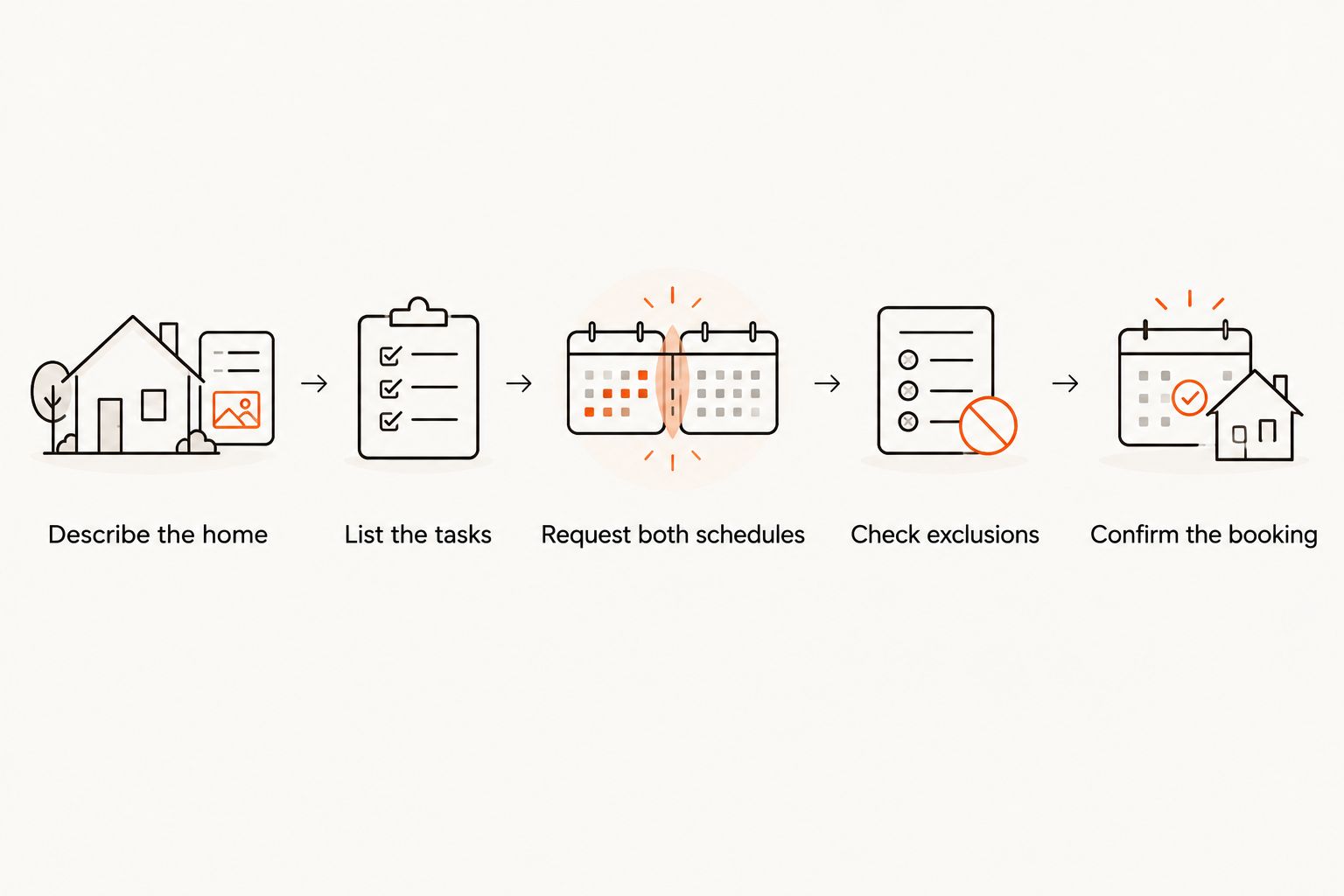
Use the same brief for each cleaner. This process keeps differences visible without forcing every provider to organise the job in the same way.
- Describe the home. Give the number of bedrooms and bathrooms, floor types, areas to exclude and any access constraints. Add relevant photos without exposing private information.
- List the tasks. Separate must-do work from optional extras. Name surfaces and jobs rather than writing only that you want a thorough clean.
- Request both schedules. Ask for weekly and fortnightly options against the same brief. Request a clear explanation wherever the scope or time allowance differs.
- Check exclusions. Confirm supplies, initial cleaning, occasional tasks and booking terms. Ask for unclear items to be resolved in writing.
- Confirm the booking. Accept the scope, schedule and terms you actually want. Keep the written agreement so you can check later changes against it.
The goal is a clear decision, not identical-looking documents. Different quote formats are manageable when each answers the same questions.
A job description you can adapt
For a 2026 cleaning request, write a short description in your own words using the prompts below. Replace general phrases with details about your home before posting.
- Home: State bedrooms, bathrooms, floor types and rooms you want excluded.
- Regular work: List the bathroom, kitchen, dusting and floor tasks you want completed each visit.
- Frequency: Request weekly and fortnightly options, including the proposed cleaner-hours for each.
- First visit: Describe the current condition and ask whether separate initial work is needed.
- Extras: Identify any oven, window, cupboard or linen tasks you want quoted separately.
- Practical details: Explain access, pets, equipment arrangements, product restrictions and preferred booking days.
Finish by asking the cleaner to identify exclusions and explain how additional work is approved. This gives you a written basis for comparing responses without assuming every quote includes everything you listed.
QuickQuote lets you post your house cleaning job free and choose who to hire. Use the brief to make the quotes easier to compare, rather than treating the marketplace as the cleaner responsible for the work.
Post a clear cleaning job
Free to post, no connection fee, up to three local tradies. You choose who to hire.
Post your jobWhat should you check before accepting a quote?
Check the written scope first. Then check how the arrangement works when something changes, because a recurring booking needs more detail than an agreed day.
Ask who your contact is if the assigned cleaner changes or cannot attend. Confirm how you will hear about rescheduling, and what you need to do if you cannot provide access.
Discuss keys, alarm instructions and pets before the first visit. Share access details through an agreed method rather than putting sensitive information in a public job description.
Finally, ask how to report missed work and what process applies to concerns. Do not assume a return visit, refund or guarantee exists unless the provider expressly agrees to it.
Accept a quote you can explain back in plain language: what gets cleaned, how often, what is excluded and how changes are approved.
Does fortnightly cleaning always mean less work overall?
Every 14 days describes the visit interval, not how much cleaning your household needs. Decide what you will handle between bookings and what you expect the cleaner to do on arrival.
Compare the recurring arrangement with your own workload. If you dislike the tasks left between visits, the schedule needs another look even when the quote itself is clear.
Should the first clean be compared separately?
The first clean should be separate when its scope differs from the recurring service. Ask which tasks bring the home to the agreed starting condition and which tasks continue afterwards.
Keep that distinction in your comparison. Otherwise, an initial visit can distort your view of the ongoing arrangement.
Can you change from weekly to fortnightly cleaning?
Ask the provider to confirm any change before treating it as agreed. A different interval needs a fresh check of the task list, cleaner-hours and booking terms.
Record the new schedule in writing. Do not assume the original per-visit arrangement carries over unchanged.
FAQ
How do I compare house cleaning cost without missing extras?
Compare the same task list and period, then check exclusions separately. Ask about the first clean, supplies, occasional tasks and approval for additional work.
Is weekly or fortnightly house cleaning better for my home?
Weekly cleaning is better for shorter gaps between scheduled cleans; fortnightly cleaning is better for fewer appointments. Choose according to the work you want covered and what you will handle between visits.
How many cleaning visits should I compare?
Compare 4 weekly visits with 2 fortnightly visits over 4 weeks. Confirm that the actual booking schedule and agreed tasks match that comparison.
What are cleaner-hours on a house cleaning quote?
Cleaner-hours describe the combined working time of the cleaners. For example, 2 cleaners working for 2 hours provide 4 cleaner-hours, but the task list still determines what work is agreed.
Does a regular house clean include the oven and windows?
Treat oven and window cleaning as included only when the written quote says so. Specify inside or outside surfaces and ask whether the work is recurring or separately arranged.
Do I need to supply cleaning products and equipment?
Confirm supplies and equipment directly with the cleaner before accepting the quote. List any product restrictions and agree who provides the vacuum, mop and other items.
Can QuickQuote help me compare house cleaning quotes?
QuickQuote is a quote-matching marketplace where you can post a house cleaning job free and receive quotes from up to three local tradies. There is no connection fee, you choose who to hire, and three replies are not guaranteed.
One last thing
A rotating task list needs a record, not just an intention. If you agree that some jobs happen occasionally, write down which visit includes them and how they fit within the booking.
Before accepting your 2026 cleaning quote, ask one final question: what work will not get done under this arrangement? Clear exclusions are as useful as clear inclusions. They tell you what you still need to organise.
Related guides

Connecting homeowners with trusted local tradies. Made in Sydney.