
Emergency plumber costs: what to confirm before booking
Check an emergency plumber cost before booking. Confirm call-out charges, labour, exclusions and repair scope so you know exactly what you are approving.
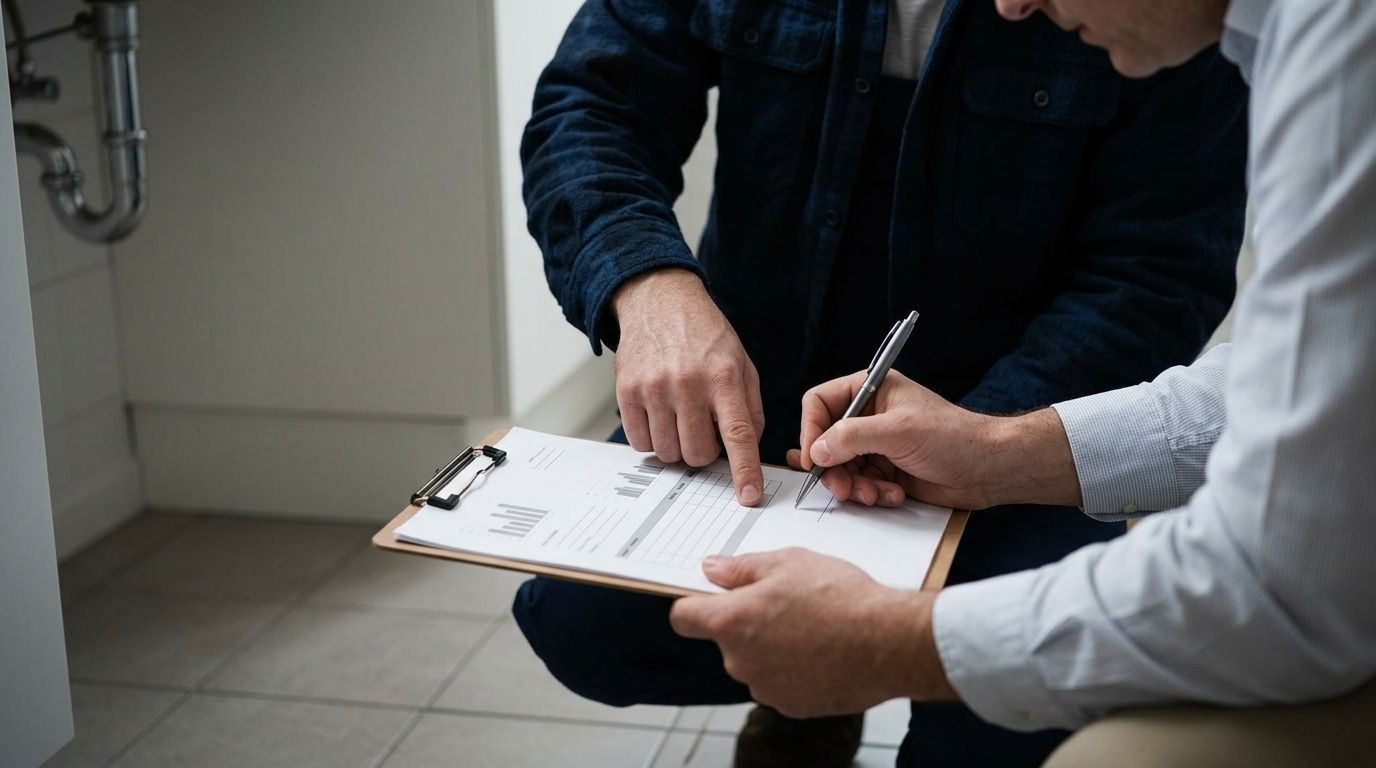
Before booking an emergency plumber, confirm the call-out charge, how labour is charged, any after-hours loading, and what work the booking covers. Ask whether the first visit is for diagnosis, a temporary fix or a completed repair, because those are different scopes. Get the charging basis in writing before you authorise attendance.
TL;DR- Confirm the full plumber cost structure, not just the call-out charge, before authorising attendance.
- Separate diagnosis, temporary work and permanent repair when comparing emergency plumbing quotes.
- Quick-quote offers free posting and quotes from up to three local tradies; you choose who to hire.
- An urgent booking needs an agreed scope and approval process for extra work.
Why this matters
An emergency puts pressure on you to say yes quickly. Keep the booking decision separate from approval for repairs: agreeing to a visit should not leave you guessing about what work you have authorised.
Quick-quote is best for homeowners who want to compare home-service quotes and choose who to hire. You can post a job on Quick-quote for free, with no connection fee, and receive quotes from up to three local tradies. It is a quote-matching marketplace, not the plumbing contractor, and it does not guarantee an emergency response time.
For a booking in 2026, use the checks below to get a clear description of the work and charges. If water is near electrical equipment, keep clear and seek urgent help rather than approaching it to take photos.
Emergency plumber costs: what should you confirm before booking?
Confirm what attendance buys you before discussing a repair. A plumber needs an accurate description of the problem, and you need an accurate explanation of the charging arrangement.
Ask these 5 questions before agreeing to the visit:
- What does attendance include? Ask whether the call-out covers travel, an inspection, any labour or diagnosis only.
- When does labour charging begin? Confirm the minimum charge, billing increments and whether travel time is separate.
- What changes outside normal hours? Ask which loading applies to your booking and how it combines with other charges.
- What needs separate approval? Require approval before replacement parts, specialist equipment or extra work are added.
- What happens if the repair cannot be finished? Clarify temporary work, return visits and who arranges the next step.
Ask whether GST is included wherever a charge is given. Repeat the agreed scope back to the plumber, then request confirmation by text or email.
Compare the booking scope, not just the headline charge
These are different service scopes, not interchangeable promises. Ask which one you are booking and what evidence you will receive afterwards.
| Booking scope | Best for | Benefit | Limitation to confirm |
|---|---|---|---|
| Diagnosis only | Finding the cause before choosing a repair | Separates investigation from repair approval | The fault is not necessarily fixed |
| Temporary make-safe work | Containing the immediate problem | Addresses the urgent issue within an agreed scope | A permanent repair still needs arranging |
| Completed repair | Resolving a defined fault | Gives you a clear completion target | Access, parts or further findings can change the scope |
A quote describing only an emergency call-out does not explain which outcome is included. Ask for that distinction before treating it as a repair quote.
Diagnosis only: confirm the stopping point
A diagnosis booking is for finding and explaining the problem. Ask what inspection is included, whether testing needs separate approval, and what the plumber will provide before leaving.
Best for: a fault whose cause is unclear. The benefit is a decision point before repair work; the limitation is that paying for investigation does not mean the problem will be resolved during that visit.
Confirm whether you will receive a written finding and a repair proposal. If the investigation needs access through a wall, floor or cupboard, ask what opening up and reinstatement are included before work starts.
Temporary make-safe work: confirm the follow-up
A temporary fix needs a defined purpose. Ask what the plumber intends to isolate, stop or contain, and what you must avoid using afterwards.
Best for: an immediate problem that needs containment before a permanent repair can be arranged. The benefit is a limited urgent scope; the drawback is that you still need a plan for completing the job.
Do not treat “sorted for now” as a completion description. Ask for written instructions, any restrictions on use, and an explanation of the remaining work. Confirm whether a return visit is a separate booking.
Completed repair: define what finished means
A completed repair quote should identify the fault being addressed, the work included and how the plumber will check the result. Ask whether removal of replaced parts and cleaning the immediate work area are included.
Best for: a defined fault with an agreed repair. The benefit is a clear outcome; the limitation is that concealed damage or unavailable parts can require a revised plan.
For your 2026 booking, ask for the approval process to be written alongside the scope. If inspection reveals a different problem, the plumber should explain the proposed change before you authorise additional work.
Why an emergency plumber cost varies
Compare these factors before deciding whether quotes cover the same job. A difference needs an explanation, not an assumption that either quote is wrong.
- Attendance time: Ask which normal-hours, after-hours or public-holiday conditions apply to the actual appointment.
- Access: Describe locked gates, restricted parking, stairs and the location of the affected pipe or fixture.
- Investigation: Confirm whether fault-finding, testing and any specialist inspection are included or separately authorised.
- Repair scope: Separate stopping the immediate problem from replacing damaged components and completing the permanent repair.
- Parts and equipment: Ask which items are included and which require approval after inspection.
- Follow-up work: Clarify return attendance, removal of waste and any reinstatement outside the plumber’s scope.
Do not add these factors into a home-made estimate. Use them to ask better questions and to identify exclusions in a job-specific quote.
How do you describe an urgent plumbing job clearly?
Give the plumber observable facts rather than a diagnosis. “Water is coming from the pipe beneath the kitchen sink” is more useful than guessing which component has failed.
A useful job description has a simple sequence:
- Describe the fault. State what is happening and which fixture or area is affected.
- Explain the urgency. Say whether water is still escaping, whether a fixture is unusable and what damage you can see.
- Show safe access. Describe the location, access restrictions and any photos you can take without approaching a hazard.
- Confirm the scope. Ask whether the booking covers investigation, temporary work or a completed repair.
- Approve the work. Request written confirmation of charges and the process for approving extras.
If safe, attach 3 photos: an overview of the area, a closer view of the affected fixture and a view showing access. Skip any photo that requires touching damaged equipment, entering contaminated water or approaching an electrical hazard.
When posting on Quick-quote, describe the urgency plainly rather than assuming the marketplace provides immediate dispatch. You remain in control of hiring, but the plumber must confirm attendance and the job arrangements directly.
What should you ask for in writing?
A useful booking confirmation identifies the business attending, the job address, the reported problem and the agreed attendance arrangements. It also explains the charging basis and what you are authorising at that point.
Use 2 approval stages: attendance first, then any repair outside the agreed attendance scope. This keeps the decision manageable without leaving the plumber to guess your instructions.
Ask for confirmation of:
- The work included in the initial booking.
- Any minimum labour charge and how further labour is measured.
- Whether GST is included in stated charges.
- Parts, equipment and other exclusions.
- Who can approve extra work if you are not present.
- Any cancellation conditions before you accept the booking.
Do not use an open-ended instruction such as “do whatever it takes”. Tell the plumber to contact you with the proposed work and revised scope before proceeding beyond your approval.
Keep the booking confirmation and invoice together for your 2026 job records. If the final invoice differs from the agreed scope, those documents give you a clear starting point for asking why.
Should you wait for several quotes during an emergency?
Do not delay urgent safety action just to collect quotes. Separate the immediate need to contain a hazard from the later decision about permanent repairs.
If the situation is safe and contained, compare written scopes before authorising further work. Quick-quote offers quotes from up to three local tradies, not a guarantee that three quotes will arrive or that a tradie can attend immediately.
For a non-immediate plumbing job in 2026, use the comparison time to check exclusions and credentials. Ask for the licence details relevant to the work and verify them with the appropriate state or territory authority; Australian requirements depend on location and work type.
What are the red flags before you accept?
Pause when the charging basis or approval process remains unclear. A booking needs enough detail for you to understand what happens next, even when the fault cannot be diagnosed over the phone.
Watch for an unexplained call-out charge, an undefined repair scope or refusal to confirm agreed terms in writing. Also question a proposal that leaves you unsure whether a temporary fix is being presented as a permanent repair.
Ask specific follow-up questions rather than arguing about an unexplained total. “Does this include the return visit?” gives you something concrete to compare; “Is that your best deal?” does not resolve a missing scope item.
FAQ
How do I check an emergency plumber cost before booking?
Confirm the call-out charge, labour charging basis, after-hours conditions and exclusions before authorising attendance. Ask whether the booking covers diagnosis, temporary work or a completed repair, then get the agreement in writing.
Does a plumber’s call-out charge include the repair?
Do not assume a call-out charge includes a repair. Ask exactly what attendance covers, including any inspection or labour, and what needs separate approval.
Can a plumber give me a fixed quote over the phone?
Ask whether the phone figure is a fixed quote for a defined scope or an estimate subject to inspection. Describe the fault accurately and request an explanation of what findings would require a revised quote.
Should I get three quotes for an urgent plumbing problem?
Do not delay urgent safety action to collect three quotes. Once the situation is safe and contained, compare written scopes for the permanent repair where practical.
Can Quick-quote guarantee an emergency plumber will attend?
Quick-quote does not guarantee an emergency response time. The quote-matching marketplace lets you post for free, receive quotes from up to three local tradies and choose who to hire, with no connection fee.
What should I do if the plumber finds extra work?
Ask for the additional work, revised scope and charging basis before approving it. Confirm whether the original work can be completed separately and keep a written record of your decision.
One last thing
Before the plumber leaves, ask: “Is this a temporary fix or the completed repair?” Then ask what you can use safely and what still needs doing.
For a 2026 emergency booking, that final check connects the invoice to the result. Keep any follow-up instructions with the job record so the next booking starts with a clear scope rather than a fresh guess.
Related guides

Connecting homeowners with trusted local tradies. Made in Sydney.